Lifetime Citizen Portal Access — AI Briefings, Alerts & Unlimited Follows
Portland SD 1J board reviews self-evaluation, flags accountability and confidentiality gaps
Loading...
Summary
At a March 31 self-evaluation session facilitated by OSBA, Portland SD 1J trustees identified strengths in cultural responsiveness, data use and budgeting but flagged accountability, systems thinking and executive-session confidentiality as priorities for follow-up; the board agreed to pursue a monitoring calendar and further work during its strategic-planning cycle.
The Portland SD 1J Board of Education met March 31 for a facilitated self-evaluation session during which trustees reviewed a research-based instrument and identified both strengths and areas needing action. Dr. Kristin Miles of the Oregon School Boards Association led the discussion and summarized the board’s top self-identified strengths as “cultural responsiveness, using data for continuous improvement and budgeting and financial accountability.”
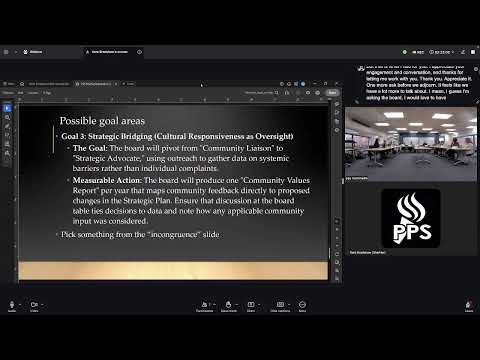
Board members said the instrument revealed wide variation in responses across several questions, which trustees and the facilitator attributed partly to differences in tenure and in how some questions were read. Several members urged the board to use the results to set one or two concrete board-level goals and to develop a monitoring calendar that schedules when the board will review outcome data tied to strategic priorities.
Director Stephanie Englesman said she was “surprised and somewhat concerned” by the range of responses on questions about preserving executive-session confidentiality and the proper channeling of complaints, warning that confidentiality lapses could carry legal consequences. Dr. Miles acknowledged those concerns and offered to pull question-level data so the board can examine which items are driving the incongruence.
Trustees discussed the governance/operational distinction recommended by the OSBA tool: board members should focus on high-level questions — what is the target, what is the current data, and what systemic adjustments are needed — and avoid directing operational tactics to staff. Trustees agreed that major items such as rightsizing, school consolidation and budget trade-offs are appropriately discussed at the board level but that operational remedies should be left to the superintendent and staff.
Several trustees raised the practical difficulty of instituting a formal monitoring calendar while the district continues to navigate repeated, deep budget cuts; one participant said the district had cut “over $120,000,000” across recent years, underscoring the challenge of expecting steady outcome improvements in a constrained fiscal environment. Staff noted that the board’s current goals and the district’s strategic-planning timeline (board goals expire in 2027) create an opportunity to formalize monitoring practices and pair that work with community engagement under the district’s “Growing Great Schools” outreach.
The board also discussed including student input as an early indicator in monitoring new curricula or program changes so trustees can assess student experience alongside outcome metrics. Dr. Miles recommended the board pick a limited set of priorities to act on and to embed a monitoring plan in the strategic-planning process.
No formal motions or votes were taken during the session. Trustees generally supported convening further work on the evaluation results at a future retreat or work session. The meeting adjourned after the facilitator offered draft goals and the board agreed to follow up with staff on scheduling and next steps.