Get Full Government Meeting Transcripts, Videos, & Alerts Forever!
Get email alerts on the Park Lighting topic
No spam. Unsubscribe anytime.
Mesa council discusses $880,000 increase for ballpark LED conversion; staff cites long-term energy and maintenance savings
Summary
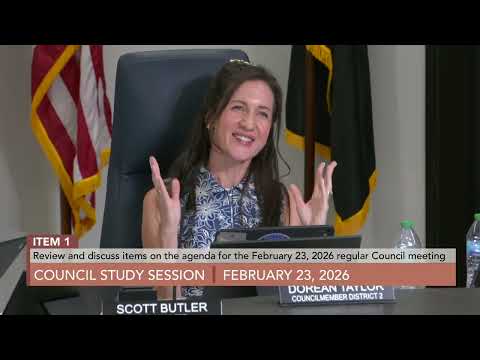
At a Feb. 23 study session the Mesa City Council questioned a roughly $880,000 increase on a proposed LED conversion at Hohokam and Fitch parks. City staff said the work is funded from general capital dollars, will replace lights on five ball fields and yield energy and maintenance savings; rebate details will be provided later.
Mesa — At a Feb. 23 study session, city staff told the Mesa City Council that a proposed LED conversion of ballpark lighting at Hohokam and Fitch parks will be paid from general capital dollars and includes an approximately $880,000 increase over what councilmembers expected.
"This is just replacing these facilities... we've been in the process of converting all of our ball field lights from metal halide to LED," said Mark (staff), who described LED fixtures as "more efficient" and said the bulbs "last longer," reducing maintenance and electric usage.
Council members pressed for more detail on where the additional dollars would come from and whether the city has completed a lifecycle cost analysis comparing LEDs to metal halide fixtures. One council member said their review showed bulb-replacement costs were modest but emphasized that "LED lighting generally saves or cuts electricity by anywhere from 50 to 70%," a long-term efficiency that can justify short-term higher costs.
Staff said the proposed increase covers both the LED conversion and the underlying annual lighting and maintenance services the parks department performs citywide, and that the request will allow replacement of lighting across five ball fields. The council asked staff to include a clear breakdown of project costs, lifecycle savings, and any rebate amounts in the council report.
Questions about rebates came up during the discussion. The mayor asked whether energy partners such as the Solvera Project offer incentives; staff said incentives exist, that Mesa's electric utility does not offer the same incentives in all service territories, and that the city recently worked with Red Mountain on similar projects. Staff committed to providing exact rebate amounts in a follow-up report.
The LED conversation was discussed alongside stadium facility-use agreements. Staff said upgrades are part of scheduled ten-year milestones in the agreements with spring-training tenants and noted that scoreboard replacements are sometimes driven by rapid technology changes, such as automated replay and pitch-review features. Staff cited the Cubs' facility agreement (entered around 2011/2013) and said the Cubs' agreement is a 30-year contract, while the A's agreement is a 25-year contract.
On economic impact, staff estimated an average March tax-revenue increase of about $2,500,000 associated with spring-training activity but said the city could not attribute the entire increase solely to spring training.
The council directed staff to return with a report that includes precise rebate figures, a lifecycle cost comparison for LED vs. metal halide lighting, and a clear accounting of the $880,000 increase.
Votes at a glance: During the study session the council moved to acknowledge receipt of board minutes (motion credited in the exchange to Mr. Adams with Miss Taylor acknowledged in the motion sequence) and the chair declared the motion passed; the study session was later adjourned.