Get Full Government Meeting Transcripts, Videos, & Alerts Forever!
Get email alerts on the Executive Order 26 01 Ipsh topic
No spam. Unsubscribe anytime.
OHCS Details 'Intensive Permanent Supportive Housing' Under Executive Order 26-01; No New Funding Requested
Summary
Oregon Housing and Community Services briefed the subcommittee on Executive Order 26-01 and plans to use existing capital, rental assistance and leveraged OHA Medicaid billing to fund an intensive permanent supportive housing model that adds 24/7 services and on-site clinical support without a request for new legislative dollars.
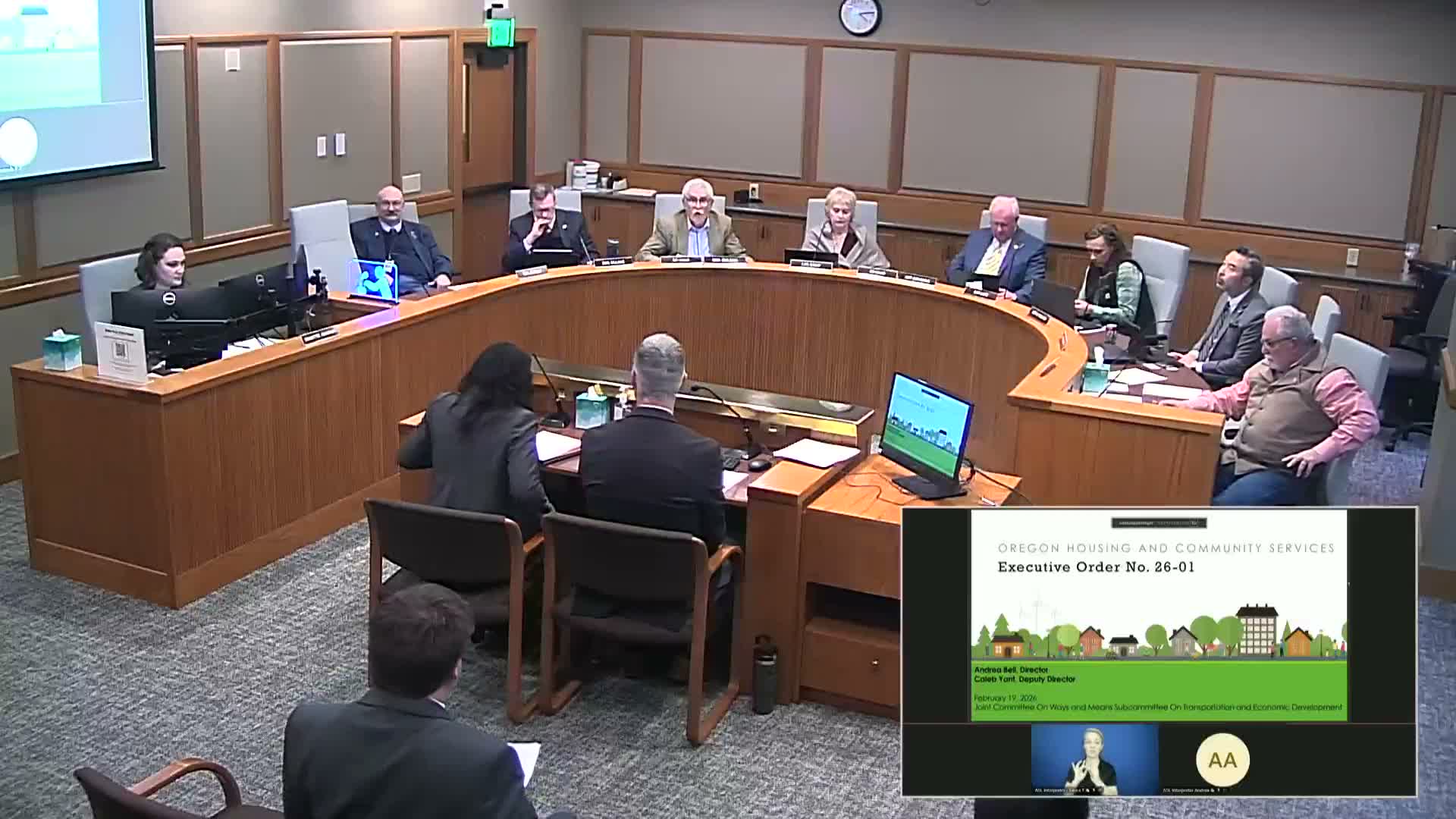
Oregon Housing and Community Services on Feb. 19 briefed the Joint Ways and Means Subcommittee on Executive Order 26-01 and outlined an "intensive permanent supportive housing" (IPSH) approach that builds on existing permanent supportive housing by adding deeper, on-site behavioral-health and tenant-support services.
Andrea Bell, OHCS executive director, said the executive order (signed in 2025) extends emergency-response authorities through January 2027 and directs OHCS and the Oregon Health Authority to partner to develop a housing-and-behavioral-health model for people with high, complex needs. "These are not our resources that we are stewarding. They are the people's resources," Bell said, stressing accountability and oversight as the agency moves to implement IPSH.
What the program will do: OHCS presented IPSH as a "three-legged stool"—capital to develop housing, rental assistance to make units affordable, and services to support tenants—with IPSH focused on deeper on-site services than standard permanent supportive housing. The agency described services such as 24/7 staffing and case management, on-site crisis response and on-site clinical behavioral-health supports that can be billed to Medicaid when appropriate. OHCS said the IPSH effort will be funded from existing agency resources (OHCS cited $20 million of capital within its current budget for IPSH) and by aligning projects with OHA-reimbursable services rather than asking the legislature for new service dollars.
OHCS provided a summary of prior legislative investments: since 2020 the legislature has provided roughly $260 million in capital funds and about $56 million in rental assistance and services for permanent supportive housing; OHCS said nearly 800 units have been opened and another ~600 are planned or under development. The IPSH initiative will prioritize projects and service providers that can demonstrate readiness to deliver integrated housing and clinical services and will incorporate service agreements into project underwriting so services are secured before financial close.
Questions from legislators focused on funding flows and program assurance. Representative Bunch asked whether a delayed or denied Medicaid waiver would create a fiscal problem; OHCS staff replied that Medicaid/OHA funds do not flow through OHCS’s budget and that service providers would bill Medicaid directly while OHCS provides capital and rental-assistance funds for the project. Committee members asked how the agencies will ensure the total funding package is sufficient for projects; OHCS said underwriting will model total development and service costs and that they plan to prioritize developers who demonstrate ability to deliver. The agency said it hopes to have a project identified by June.
What’s next: The informational hearing was closed with no action taken; OHCS will continue to refine selection criteria, modeling and documentation for IPSH and to work with OHA on service-provider billing arrangements.