Lifetime Citizen Portal Access — AI Briefings, Alerts & Unlimited Follows
FEMS previews Power BI reports, plans automated data‑quality fixes and expanded downloads
Loading...
Summary
FEMS staff demonstrated a new Power BI reports library and outlined near-term releases to expand download capacity, restore station IDs, and add Mesonet/ASOS inputs, while committing to automated gap‑filling and tolerance checks to clean erroneous station data before broad analytics rollout.
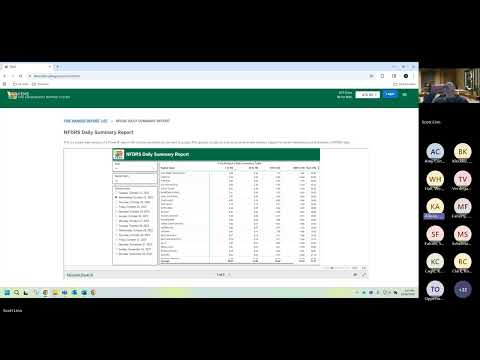
Scott, a FEMS staff member, demonstrated a new Power BI reports page and told attendees the system will let users view daily fire-danger outputs, select states or individual stations, and produce seven‑day forecasts and historical charts.
"So, you know, I'm trying to get these posted on the FEM's portal," Scott said, describing plans to host recordings and make reports available through templates that users can customize. He said templates will let units open consistent views while allowing simple filters (state, county, station, hourly or daily) to be added on request.
Why it matters: Scott and other staff framed the work as foundational — they said data integrity must be fixed before wide analytics are published so errors are not amplified. Scott described a multi-step plan that includes restoring station IDs in charts and CSV downloads, expanding concurrent data downloads, and adding automated quality-control routines that will replace implausible observations with nearest-grid values and perform gap-fills.
On downloads and releases: Scott summarized current limits — long-range requests over roughly a year are limited to a single station and shorter multi-station queries are limited to about ten stations. To support larger requests without breaking the API, the team plans a queuing system that will notify users of their position and eventually increase parallel capacity (the team is aiming for roughly seven stations at once for period-of-record downloads). He said an intended 3.5 development milestone may slip to a 3.6 release, with fuller download expansion expected in subsequent months.
Data quality and automation: In response to concerns about "bad" station data, Scott said users can remove erroneous records locally but the long-term plan — being developed with WRCC and Tim Brown — is to set tolerance thresholds so extreme values (for example, spurious 180–200 mph wind observations) are replaced by nearby grid values and the period of record is reprocessed. "If you start seeing 200 mile an hour winds, it would replace that with, you know, whatever the nearest grid point was showing for that hour," Scott said.
Modeling and operational notes: Staff emphasized that NFDRS/Nelson outputs differ from Fosberg values used by the Behave fire‑behavior model; Nelson is useful for seasonal tracking but not a direct substitute for behavior-model inputs. Scott said calibration work is underway but noted staffing changes have affected that effort.
Planned integrations: The team aims to add Mesonet state networks for the eastern U.S. and explore adding historical ASOS inputs to enable seasonal trend charts. Tracked period-of-record updates are targeted up through 2024, pending data QC and budget/prioritization decisions.
Questions and next steps: Participants asked about GAC/PSA filters, FDRA/averages in stats graphs, and measured 10‑hour stick and soil‑moisture inputs. The team said some features are data‑dependent and will be implemented as metadata and developer bandwidth allow. Scott asked attendees to forward site‑specific examples to help prioritization and calibration. The meeting concluded with no formal motions or votes recorded.