Get Full Government Meeting Transcripts, Videos, & Alerts Forever!
Get email alerts on the Stormwater Drainage topic
No spam. Unsubscribe anytime.
Norwalk to replace pipe and install box culvert at Cannon Street outfall to reduce neighborhood flooding
Summary
City consultants presented plans to replace a 36‑inch reinforced concrete pipe with a 48‑inch pipe and add a 6x6 concrete box culvert at the Betts Pond Brook outfall; staff said hydraulic modeling shows the change will mitigate local flooding and agreed to provide drainage and planting plans before the March 10 meeting.
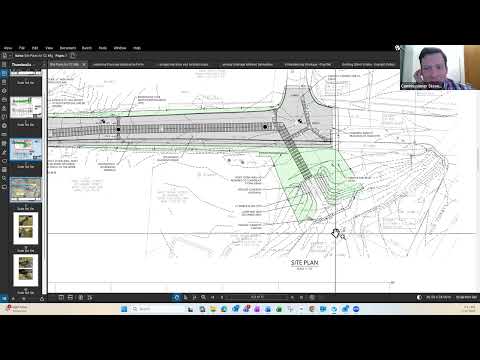
Norwalk staff and consultants presented a drainage‑improvement project for the Glen Denning–Cannon Street corridor on Feb. 24, proposing to replace an existing 36‑inch reinforced concrete pipe with a 48‑inch pipe and to install a 6‑by‑6 concrete box culvert with prefabricated wing walls at the outfall to Betts Pond Brook.
Jennifer Martinez Torres of Woodard & Curran, the project’s design engineer, told the Conservation Commission and Inland Wetland Agency the work within 100 feet of Betts Pond Brook is intended to accommodate a larger stormwater conveyance, reduce upstream flooding observed in the Glen Denning/Cannon Street area, and stabilize the existing eroded outfall.
Consultants said the city’s hydraulic analyses — run in a dynamic model and including multiple storm scenarios such as the 25‑year event — indicate the larger conveyance plus the box culvert will mitigate flood levels in the problem area and will not make upstream or downstream flooding worse. “We completed a citywide stormwater analysis and used our hydraulic model to evaluate pre‑ and post‑conditions,” Martinez Torres said. Jim Meehan, principal engineer for the Department of Public Works, said the city’s system of catch basins includes sump pits to trap sediment and that regular maintenance crews vacuum and clean those sumps as part of routine operations.
Commissioners asked for the drainage report, the model outputs and the storm scenario results to be added to the application file for review. Staff agreed to make the pre‑ and post‑construction materials available before the commission’s next meeting.
The team described in‑water protections and bank work at the existing outfall: a turbidity curtain will be used during in‑water activities, the culvert mouth area will receive riprap for scour protection and native material comparable to the streambed will be placed at the downstream edge. Consultants said they expect limited vegetation in the immediate water path and plan seeding and plantings around the riprap.
Commissioners and residents raised concerns about removal of mature trees and the condition of eroded banks at the outfall. Staff and the applicant said up to two mature trees west of the existing alignment may need removal for excavation; the team stated they had sought to avoid tree loss where possible. Public Works staff agreed to prepare a tree‑removal drawing and a replacement/planting plan consistent with the city’s Chapter 1‑12 tree ordinance and to provide a planting or restoration recommendation that could enhance bank stability and ecological resilience.
On water quality, consultants and staff said large retrofit filtration structures are often not feasible where an existing public storm system is being upsized because of space, utilities and cost constraints; however, the city’s MS4 (municipal stormwater) program inspects outfalls on a rotational basis, and the new outfall would be subject to that monitoring. Meehan said the department can consider increased sump capacity or other feasible adjustments if the location calls for it.
The commission requested that the applicant provide the drainage report, model outputs for representative storm events, and the tree‑removal/planting drawings as part of the application package. Staff said they will coordinate with the applicant and aim to bring a draft memorandum or resolution to the March 10 meeting for possible action.
The project team thanked the commission for their time.