Lifetime Citizen Portal Access — AI Briefings, Alerts & Unlimited Follows
HRSA webinar outlines APR deadline, EHB submission steps and NPI rules for SLRP awardees
Loading...
Summary
HRSA staff told State Loan Repayment Program awardees the Academic Year 2024–2025 APR must be submitted through the EHB between Aug. 1 and Aug. 31, 2025, warned that extensions are not permitted under the statute, reviewed required forms and data elements (including NPI rules) and said HRSA will follow up to clarify closeout deadlines.
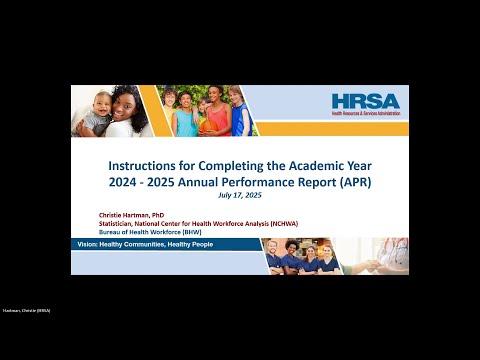
Christy Hartman, a statistician at the National Center for Health Workforce Analysis within the Bureau of Health Workforce at the Health Resources and Services Administration, led a webinar explaining how State Loan Repayment Program awardees should complete the Academic Year 2024–2025 Annual Performance Report (APR). Hartman said the APR is a statutorily required, annual submission and that Office of Management and Budget approval covers the forms and fields the agency uses.
“The APR is required each academic year for all grants and cooperative agreements,” Hartman said, and she told attendees the APR submission captures award‑related activities for the performance period Sep. 1, 2024, through Aug. 31, 2025. Hartman and program staff said the Electronic Handbooks (EHB) will open for APR data entry on Aug. 1 and that awardees must submit their APR by Aug. 31, 2025, at 11:59 p.m. Eastern. “Because this is a statutory deadline, there are no extensions,” Hartman said.
The webinar walked attendees step‑by‑step through the submission process: review the program manual and wireframe, test browser settings, log in to EHB via login.gov, complete required forms in order, resolve validation errors, and save a copy of submissions. Hartman emphasized saving work frequently and resolving validation errors rather than entering incorrect data to bypass validations. Awardees were told to contact the EHB help desk for technical issues and to include help‑desk ticket numbers and grant numbers when escalating to project officers.
HRSA reviewed the two principal form groups used for SLRP APRs. The eXp1 (experiential characteristics) form collects site‑level information such as site name, address, type of setting, partners, vulnerable population served and HPSA data; eXp1 must be completed before provider‑level forms so sites will populate correctly. The individual‑level form (referred to in the webinar transcript as the Indigent/InGen/Imagen form) collects provider demographics, unique identifiers, graduation status and financial support amounts. The agency added validations this year to reduce duplicate or incorrect identifiers and to prevent use of facility NPIs in place of individual NPIs.
On the National Provider Identifier (NPI) requirement, presenters said individual NPIs are an important data element for tracking outcomes and that awardees should encourage providers without NPIs to apply through the National Plan and Provider Enumeration System. Program staff clarified exceptions: certain provider types (for example, some registered nurses, behavioral health professionals and expanded practice dental hygienists) may not have individual NPIs and the system will allow blanks for those cases; however, program staff stressed that the system will not accept facility NPIs for individual provider records.
The program office also reviewed closeout timelines and related deadlines. Program staff said the final program report is due 90 days after a project period ends, the liquidation period is typically 120 days, final Federal Financial Reports (FFRs) for closing awards are due Jan. 30, 2026 (or 120 days after a no‑cost extension ends), and that no‑cost extension (NCE) requests should be submitted with justifications and coordinated with project officers (HRSA staff suggested Aug. 21, 2025 as the practical minimum timing for NCE submission prior to project end).
Several attendees raised questions about apparent conflicts between dates shown on the current wireframe and the dates presented during the webinar. One attendee asked whether the APR due date should be later for awards that are closing; program staff acknowledged the discrepancy, said they would confirm correct dates with leadership and promised a follow‑up message to clarify which deadlines apply to awards that are closing versus those continuing into the next project period.
Hartman closed by urging awardees to start APR data entry early, to use the current year Excel templates for uploads (do not reuse prior templates or modify the worksheet structure), to process uploaded data using the EHB process button before saving and validating, and to coordinate with project officers about validations, NCEs and closeout steps. She apologized for the earlier date confusion and said HRSA would send a clarifying message to participants.
The webinar included multiple question‑and‑answer exchanges in which attendees sought clarification about NPI applicability, the timing of final reports and FFRs after approved NCEs, and the mechanics of using the EHB Excel template. Program staff provided the agency’s current guidance and committed to confirming and communicating any corrections to the published wireframe and deadline dates.