Lifetime Citizen Portal Access — AI Briefings, Alerts & Unlimited Follows
HRSA webinar outlines changes to State Loan Repayment Program, clarifies state‑level application process
Loading...
Summary
HRSA presenters summarized the State Loan Repayment NOFO (HRSA‑26015), saying states (not individuals) apply, awards begin in July, eligible disciplines expanded, and full‑time award amounts increased to $75,000 (initial two‑year service); slides and a recording will be shared with registrants.
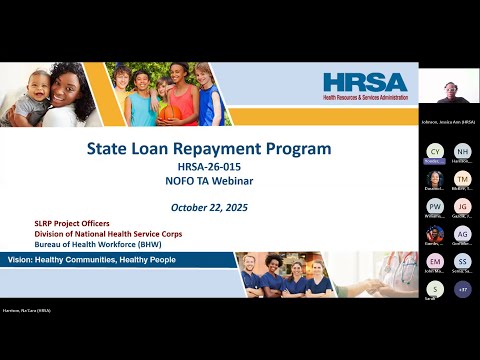
HRSA presented the NOFO technical‑assistance webinar for the State Loan Repayment Program (HRSA‑26015), emphasizing that states or state‑designated entities — not individual clinicians — must apply to receive funds that states then distribute to eligible providers.
"The mission of the Bureau of Health Workforce improves the health of underserved population by strengthening the healthcare workforce, connecting skilled professionals to communities in need with education, training, and service," said Jessica, a presenter with the Bureau of Health Workforce, summarizing the program's goal and its focus on federally designated Health Professional Shortage Areas (HPSAs).
Why it matters: The NOFO introduces several substantive changes that alter how states design and deliver loan‑repayment awards to clinicians. HRSA said awards for full‑time primary‑care providers have been raised to $75,000 for an initial two‑year service obligation (up from $50,000 in prior cycles), and halftime initial contracts are $37,500. Discipline eligibility was expanded to include dental therapists and registered dietitians as members of the primary‑care team, and HRSA signaled reduced administrative cost allowances and renewed match requirements for states.
What HRSA told applicants: Presenters walked through the four critical application elements — participant eligibility; discipline eligibility; practice site eligibility; and program administration, management and oversight — and said states must demonstrate the program will be administered by a state entity or designee. Portia Williams, who led the criteria review, said: "The critical elements are participant eligibility, discipline eligibility, practice site eligibility, and program administrative management and oversight." Applicants must also show plans for evaluation, NPI‑level data collection, sustainability after federal funds end, and a reasonable budget with match funds.
Application logistics and timeline: HRSA staff noted the FY‑cycle awards will be made beginning in July; after states receive awards they set their own timelines and procedures for accepting individual applications. The webinar reiterated that individuals cannot apply directly to HRSA for this NOFO; clinicians should apply to the state program once their state (or its designee) has been awarded federal funds. HRSA staff also reviewed standard forms (SF‑424 and budget forms), reminded applicants that the Unique Entity Identifier (UEI) via SAM.gov replaced the DUNS number in 2022, and explained cumulative budget behavior in the application portal.
Common questions from participants: During Q&A, presenters addressed recurring points: how states designate applicant entities (the state chooses its designee, not HRSA), whether award payments are taxable (presenters stated that for the State Loan Repayment Program payments are not taxable income), how to document prior loan payments for continuations (states typically require proof that prior awards were applied to loan principal), and what counts as allowable match (federal sources generally do not count toward the nonfederal match). HRSA said examples of acceptable match include state appropriations, private foundation or corporate donations, community organization funds, or contributions from eligible practice sites.
Next steps and materials: Presenters said they will share the webinar slides and a recording with registrants, and they posted state point‑of‑contact information in the chat during the call. HRSA advised applicants to follow the specific application instructions cited in the NOFO and to contact the grants management team with technical form questions.
The webinar concluded with presenters inviting participants to send additional questions by email; HRSA staff said they will publish uniform answers to common questions along with the slides and recording.