Lifetime Citizen Portal Access — AI Briefings, Alerts & Unlimited Follows
Florida advisory committee hears state officials on keeping elections running after disasters
Loading...
Summary
Florida Secretary of State Cord Byrd told the U.S. Commission on Civil Rights’ Florida advisory committee that the state uses targeted executive orders and preexisting emergency plans to preserve voting access after hurricanes and other emergencies; Byrd said email and fax are not permitted for casting ballots except for UOCAVA voters.
TALLAHASSEE, Fla. — Florida Secretary of State Cord Byrd told the U.S. Commission on Civil Rights’ Florida advisory committee on April 9 that the state relies on targeted executive orders, coordinated county‑state plans and prepositioned resources to keep elections running during natural disasters.
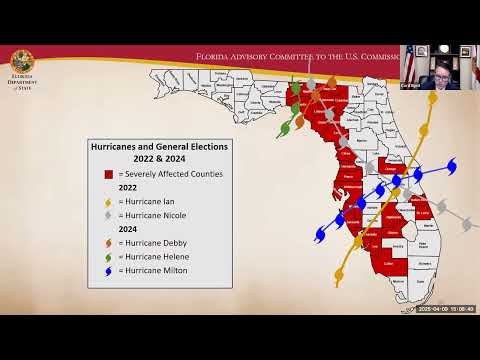
Byrd, the state’s chief elections officer, said the constitution and state law set the framework for elections, and that Florida does not postpone general elections but instead uses emergency executive orders to extend deadlines or allow temporary adjustments. “We do not move or delay elections,” Byrd said. He told the committee the state issued executive actions after major storms in 2022 and again in 2024 to extend eligibility verification and reporting deadlines, permit supervisors to establish additional voting sites, and enable relocation or consolidation of polling places when necessary.
The committee convened as part of a two‑part series; its staff will compile testimony into a report for the U.S. Commission on Civil Rights. Byrd cited Hurricane Ian (landfall Sept. 28, 2022) and subsequent storms as examples in which executive action combined with county coordination to preserve voter access. He also noted 2024 saw unusually high turnout statewide and cited Taylor County reporting 90.9% turnout as an example of continued participation despite storm impacts.
Committee members pressed Byrd on safeguards to ensure emergency measures are applied uniformly across counties and not shaped by local political leanings. Chair Nadine Smith raised the 2018 Bay County incident, when supervisors accepted ballots submitted by email and fax during Hurricane Michael, asking what prevents uneven application today. Byrd said the state consults directly with supervisors, relays county needs to the governor’s office, and crafts executive orders to address particular local conditions while staying “as close as possible” to existing state law. “We reach out to the counties and … once the hurricane hits, … we ask what do you need?” Byrd said.
On whether email or fax can be used to submit ballots in emergencies, Byrd said those methods are not permitted under current Florida law except for limited use by UOCAVA (Uniformed and Overseas Citizens Absentee Voting Act) voters. “Email and fax would not be permitted under state law, as it stands currently,” he said, adding that drafted executive orders aim to conform closely to statutory guardrails.
Members also asked whether the federal Cybersecurity and Infrastructure Security Agency (CISA) and other federal partners remain available to assist. Byrd and county officials said federal partnerships, including CISA and Homeland Security, have been important: Florida deploys “cyber navigators” and maintains state teams to assist county IT systems, while counties and the state welcome external testing and assistance.
The hearing recorded additional operational detail and county perspectives, and committee members signaled they will include these points in their report to the commission. No formal votes or policy decisions were taken at the briefing; the committee invited written comments through May 9, 2025.