Lifetime Citizen Portal Access — AI Briefings, Alerts & Unlimited Follows
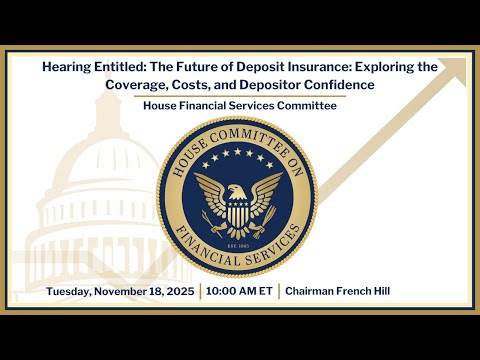
House Financial Services committee examines options to modernize deposit insurance; witnesses split on temporary guarantees vs. permanent coverage increases
Loading...
Summary
Witnesses and members debated expanding FDIC coverage for noninterest bearing business accounts, an emergency transaction‑account guarantee (eTAG), data gaps at regulators, and tradeoffs including moral hazard, cost allocation, and burden on small banks. No formal action taken.
The House Committee on Financial Services held a multi‑hour hearing to examine the U.S. deposit insurance framework, competing reform proposals and lingering data gaps after the 2023 regional bank failures. Witnesses from midsize and community banks, trade groups and policy organizations set out sharply different views on whether Congress should authorize a temporary systemwide guarantee to halt runs quickly or enact targeted permanent increases to coverage for business transaction accounts.
Chair opening and scope
Chair opened the hearing saying it would be "thoughtful, deliberative, and data driven," and framed the conversation around reforms to deposit insurance and bank resolution that aim to prevent bank failures like those seen in 2023. He reiterated the committee’s interest in balancing system stability, market discipline and fair allocation of costs.
What witnesses told lawmakers
James Ryan, chairman and CEO of Old National Bancorp, told members that mid‑sized and community banks lost deposits in March 2023 and that "Approximately 30% of our balances are uninsured," describing large deposits from universities and hospital systems that can run into the multimillion‑dollar range. Ryan urged targeted measures such as the Main Street Depositor Protection Act and said modest industry‑funded premiums (he cited industry estimates of "2 to 5 basis points") would be far cheaper than the wholesale funding costs banks face during stress.
Jill Castilla, president and CEO of Citizens Bank of Edmond, disagreed that coverage shortfalls were the core problem. "The 2023 turmoil was a crisis of confidence, not a crisis of coverage," she said, recounting how her bank reached out to uninsured customers, used reciprocal deposits and collateral tools, and kept deposits local. Castilla warned that broad expansions of FDIC guarantees "would create moral hazard, weaken market discipline, and distort competition."
Chris Furlough of the Texas Bankers Association presented a two‑step plan his trade group backs: first, an emergency transaction‑account guarantee (eTAG) that could be invoked quickly to provide temporary coverage (he told the committee his proposal would provide a 120‑day backstop), and second, a data‑driven modernization of permanent coverage. Furlough argued speed and certainty matter in stopping runs driven by social media and fast payment systems.
Grover Norquist of Americans for Tax Reform opposed raising coverage, saying private insurance options should be expanded to avoid cross‑subsidies among banks and to prevent what he described as an implicit tax on some institutions to benefit others.
Jared Anderson of Paul Weiss urged restoring statutory authority for TAG‑style responses, inflation adjustments to the $250,000 limit and better FDIC data collection to inform any permanent changes.
Key themes members pressed
Data gaps: Multiple members and witnesses emphasized limits in current FDIC call report data. The chair quoted Acting FDIC Chair Travis Hill’s testimony that the agency lacks granular deposit‑type data required to estimate how many accounts would be affected by targeted coverage changes.
Speed vs. permanence: Lawmakers repeatedly asked whether a temporary, fast‑acting guarantee (eTAG/TAG) is preferable to a permanent coverage increase such as the Haggerty/Brooks Senate proposal (often discussed in testimony as a $10 million threshold for some transaction accounts). Proponents of eTAG argued it can stop runs quickly while preserving time for deliberation; proponents of permanent increases argued some businesses need consistent, predictable protection.
Moral hazard and cost allocation: Witnesses disagreed over moral hazard and who would pay. Castilla and Norquist warned expanded coverage could reward poor decisions and concentrate risk, while Ryan and others stressed the competitive harm when depositors flee community and midsize banks.
Operational burden for community banks: Community bankers said many small institutions do not currently report the specific deposit breakdowns needed to implement targeted reforms without significant upgrades to core systems. Castilla told the committee small banks often compute uninsured exposures manually and warned that new reporting could cost six‑figure technology investments for some institutions.
Stablecoins and shadow deposits: Members asked about stablecoins and other uninsured deposit equivalents diverting funds outside insured banking. Witnesses said the issue warrants attention but that the data are incomplete on where those funds sit and how they would behave in stress.
What’s next
No binding votes were taken. Members used the hearing to surface competing views, request more data and signal legislative priorities: some members favor near‑term statutory authority to permit regulators to invoke transaction‑account guarantees quickly; others want FDIC data collection, inflation indexing and targeted, empirically grounded changes. Members were given five legislative days to submit additional written materials for the record; witnesses were asked to return follow‑up answers by Dec. 23, 2025.
Why it matters
The debate balances two risks: abrupt depositor flight in the era of instant payments and social media amplification, and the long‑run effects of expanding government‑backed guarantees on market discipline, competition and bank funding costs. Any decision about coverage levels or emergency tools will affect who shoulders costs (banks, customers or taxpayers), how community banks compete for large business depositors, and the regulatory data and systems needed to enforce and monitor changes.
The hearing reflected the committee’s split: many Republicans and trade groups emphasized speed, fairness for community banks and protection of taxpayers; many Democrats emphasized targeted protections for small businesses and data‑driven policy. The record now will grow with written submissions and FDIC input as lawmakers consider whether to pursue emergency authority, permanent coverage changes, or a hybrid path that marries preparedness with study.