Get Full Government Meeting Transcripts, Videos, & Alerts Forever!
Get email alerts on the Computing Infrastructure topic
No spam. Unsubscribe anytime.
Argonne and Aurora to bolster ATLAS computing ahead of high‑luminosity LHC
Summary
Researchers described Argonne National Laboratory’s computational support for the ATLAS experiment, noting the Argonne Leadership Computing Facility (a U.S. Department of Energy Office of Science user facility) and the Aurora exascale system will help handle a projected ~20‑fold rise in data for the High‑Luminosity LHC beginning in 2030.
Speaker 1, Presenter, said Argonne National Laboratory is expanding computational support for the ATLAS experiment at CERN to prepare for a large increase in data volume as the Large Hadron Collider enters a high‑luminosity phase.
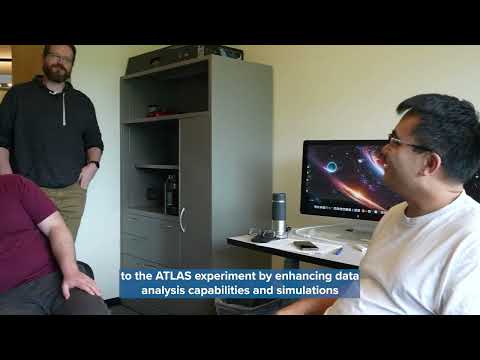
"Argonne's computational scientists are also contributing to the ATLAS experiment by enhancing data analysis capabilities and simulations through the Argonne Leadership Computing Facility, a US Department of Energy Office of Science user facility that's home to Aurora, one of the nation's first exascale supercomputers," Speaker 1 said.
Speaker 5, Presenter, described the scale of the challenge: "We will have a 20 fold increase in the data that we record." He said that the increase in event rates and data complexity will substantially raise computing and simulation demands and that advanced systems such as Aurora could help meet that demand.
The officials said upgrades to the Large Hadron Collider’s accelerator and magnets will produce more collisions and thus more events for ATLAS to record, creating requirements for both detector hardware upgrades and expanded computing capacity. Speaker 4, Presenter, stressed that detector upgrades are necessary "in order to be able to cope with all of this extra data that's gonna be coming our way."
Argonne's role extends beyond hardware, the presenters said, to include custom simulation software and data‑analysis work developed over decades. Speaker 1 said Argonne has been involved with ATLAS since the early 1990s, contributing mechanical engineering and simulation expertise that will be used in planned upgrades.
Next steps include continued software and systems development and coordination with international ATLAS partners as the LHC transitions to its high‑luminosity phase, scheduled to begin in 2030. The presentations did not specify funding amounts or contract details.