Lifetime Citizen Portal Access — AI Briefings, Alerts & Unlimited Follows
Oak Ridge project director outlines Discovery exascale supercomputer and role in DOE Genesys mission
Loading...
Summary
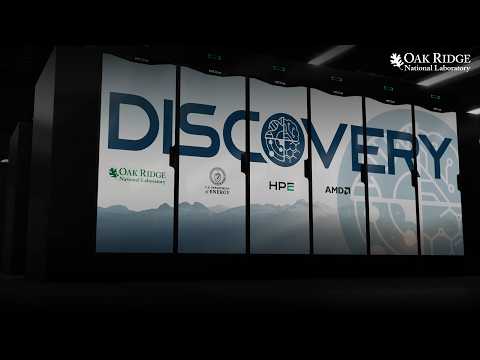
Matt Seager, project director for the Discovery supercomputer at Oak Ridge National Laboratory, said Discovery will be the nation's next exascale system, succeeding Frontier, and will support DOE's Genesys mission by enabling high-precision computation for AI training and experimental science such as fusion research.
Matt Seager, project director for the Discovery supercomputer at Oak Ridge National Laboratory, said Discovery will be the nation’s next exascale-class system and the designated successor to Frontier.
Seager told an interviewer that Discovery is "the nation's next evolution in exascale supercomputing capability" and that Frontier, which debuted in 2021, will be succeeded by the new machine.
The system is intended to serve as a foundational element of the Department of Energy’s Genesys mission, Seager said. "Genesys is not just about AI. It's about tying together AI, HPC and quantum and experimental laboratories all across the DOE complex to make discoveries that we could not do otherwise," he said.
Seager described Discovery’s computational reach as enabling work that cannot be done experimentally. As an example, he said researchers will use the system to optimize cooling salts around a fusion reactor to produce enough tritium to sustain reactions—an approach he called infeasible to test solely by building and iterating physical reactors. "This is something you have to do computationally," Seager said.
He also emphasized that Discovery will support both high-precision FP64 scientific calculations and the generation of data used to train AI models, and that those capabilities will allow the Genesys program to perform computations in support of experimental efforts across national laboratories.
The interview focused on the machine’s intended scientific role and capabilities; a deployment timeline, budget details and procurement milestones were not specified during the conversation. The remarks centered on anticipated research uses rather than formal project approvals or contract awards.
The interview concluded after the overview of technical capabilities and program role; no formal vote or administrative action was reported.