Lifetime Citizen Portal Access — AI Briefings, Alerts & Unlimited Follows
DOE-backed OPAL and Genesys projects aim to speed plant science at Oak Ridge National Laboratory
Loading...
Summary
Presenters described the Genesys mission and OPAL, linking AI, high-performance computing and an automated plant-phenotyping greenhouse at Oak Ridge National Laboratory to accelerate plant science, claiming potential productivity gains and much faster analysis turnaround.
Unidentified Speaker 1, an unnamed presenter, described the Genesys mission as “a massive initiative to design and develop the next generation of AI tools and quantum computing that is going to be, completely transformative in the way that we can accelerate scientific discovery.”
The Orchestrated Platform for Autonomous Laboratories, or OPAL, was presented by Unidentified Speaker 2 as “a cross laboratory DOE project to accelerate scientific discovery using artificial intelligence systems and high performance computing.” Speaker 2 said OPAL links AI systems to high-performance computing resources such as Frontier and connected datasets to speed analysis.
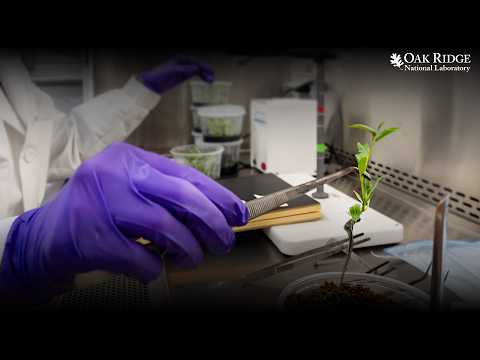
Unidentified Speaker 3, identified in the briefing as speaking from Oak Ridge National Laboratory (ORNL), described the Advanced Plant Phenotyping Laboratory (APL) as “a facility here at ORNL that is a robotic greenhouse” used to study genetics that drive plant functioning. Speaker 3 said the facility’s automation allows imaging “24 hours a day” and supports sampling schedules from daily to weekly depending on project needs.
Speakers emphasized that the imaging approach generates large volumes of image and trait data that can take months or years to analyze. “We’ve offloaded a lot of that brute force, analytics to an agentic platform that currently takes the shape of this chat interface connected to high performance computing systems like Frontier … and can use these tools to answer questions in real time,” Speaker 2 said. The presenters characterized that integration as converting the APL from“just a passive imager to an experiment that you can talk to.”
Speaker 3 asserted that pairing OPAL’s AI with plant science will “at least double our productivity,” and Speaker 1 said the work is intended to simplify manual steps and reduce time to discovery “from months to a few hours.” Those outcomes were presented as goals and claims by the speakers; the briefing did not provide independent verification or published results to substantiate the productivity or turnaround estimates.
Looking ahead, presenters said they plan to share data and models across national laboratories and make data available in data lakes and foundational models so other labs, researchers, industry and academia across the United States can use the plant-analysis tools to accelerate discoveries.
No formal decisions, motions or votes were recorded in the briefing. The presentation focused on program aims, facility capabilities and plans for data sharing rather than policy actions or procurement outcomes.