Lifetime Citizen Portal Access — AI Briefings, Alerts & Unlimited Follows
NHSC webinar details site application rules, documentation and May 6–June 17 application window
Loading...
Summary
A Health Resources and Services Administration webinar walked applicants through National Health Service Corps (NHSC) site application requirements, eligibility rules, required documents (including sliding-fee signage and MOUD attestations), and a May 21 live Q&A session; applications are open May 6–June 17.
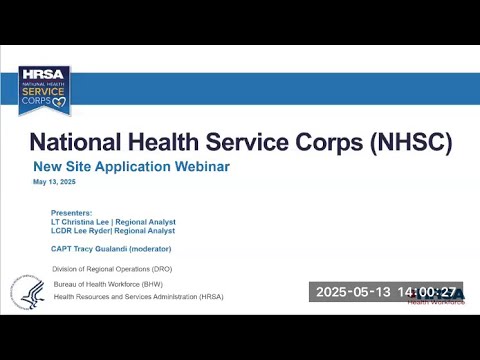
A Health Resources and Services Administration webinar on the National Health Service Corps site application outlined who can apply, what documents sites must upload, and how to avoid common application errors. Presenters from the Bureau of Health Workforce's Division of Regional Operations — Captain Tracy Galante (moderator), Lieutenant Christina Lee, and Lieutenant Commander Lee Bridal — guided attendees through account setup, eligibility rules and required evidence, and said the application cycle is open May 6 through June 17 with a live Q&A scheduled for May 21.
The webinar began with the basic eligibility criteria: to qualify as an NHSC site, a facility must provide outpatient comprehensive primary care services; be located in a Health Professional Shortage Area (HPSA) or receive an appropriate facility HPSA score; and comply with the NHSC site reference guide and the NHSC site agreement, both available on the NHSC website. "As an NHSC site, your site would be eligible to receive NHSC scholars and participants that have agreed to a loan repayment program," Lieutenant Christina Lee said, describing the program’s principal recruitment benefit.
Presenters emphasized site-type rules and exceptions. Non-auto-approved sites must apply during the open cycle and recertify every three years; auto-approved sites may apply once operational and need not recertify on that three-year schedule. Certain hospital types (critical access hospitals, rural emergency hospitals, Indian Health Service and tribally operated 638 hospitals) must be affiliated with an NHSC-approved outpatient clinic, and both hospital and clinic must operate a sliding-fee discount program and meet other eligibility conditions.
The webinar clarified ineligible sites and limits. Sites that provide only telehealth services (100% telehealth) are not eligible. Clinics that serve only a specific population (for example, veterans or active-duty military), residential facilities, and sites offering only general substance use disorder counseling without primary care or medications for opioid use disorder (MOUD) are generally ineligible. Specialty clinics are typically ineligible, with exceptions for OB-GYN, pediatric and geriatric services.
Application steps and technical requirements were reviewed in detail. Applicants must create an account and set up multifactor authentication (Google-based), and the principal site point of contact must hold the administrator role to start and submit the NHSC site application. The presenters advised applicants to save frequently while completing the online form and to check "My Sites" for any existing records to avoid creating duplicate site entries.
The webinar listed required documents and data uploads: a sliding-fee discount program (SFDP) policy and patient application, a sliding-fee schedule (six months of site-specific data is requested), recruitment and retention plan, proof of access to ancillary and specialty care (for example, laboratory or radiology partnerships and referral arrangements), and any applicable SUD documentation or MOUD attestation letters. For SAMHSA-certified opioid treatment programs (OTPs), sites should appear in the SAMHSA OTP directory by location; if not listed, sites must upload SAMHSA certification documentation.
Presenters gave precise requirements for SFDP signage and web verbiage: sites must upload one close-up photo and one distant photo showing where the signage is posted (for example, the lobby), and a screenshot of the site’s website that includes the required verbatim language. The required verbiage includes a statement that "No one will be denied access to services due to inability to pay" and that a discounted sliding-fee schedule is available based on family size and income. Presenters stressed that these items must be photographic evidence (not a Word document or PDF). They also stressed SFDP rules: eligibility for the SFDP must be based only on family size and income (sites may screen for alternate payment sources but cannot require CMS enrollment or a denial letter as a precondition for SFDP eligibility).
On staffing and service reporting, sites should list current clinical staffing and indicate full-time-equivalent (FTE) status, and they must submit six months of site-specific data to populate the NHSC site data table. Christina Lee said applicants should use the NHSC site data table guidance available in the NHSC resources section online and reminded applicants that the data requested are location-specific rather than network-wide.
Special considerations were highlighted for affiliated hospitals and special site types: NHSC participants at a hospital-affiliated site must provide weekly patient care at the affiliated outpatient clinic; hospitals should submit the outpatient clinic application first, then the hospital application. The webinar also clarified that MOUD attestation letters must be signed by the site’s CEO or medical director (a template is available on the NHSC website).
Presenters ran knowledge-check questions to reinforce key rules: required NHSC documents include the SFDP policy, proof of access to ancillary/specialty/inpatient care, the SFDP patient application, and a recruitment and retention plan. They reiterated that the SFDP cannot require patients to apply for Medicaid or present proof of insurance denial to qualify for a sliding-fee discount.
The webinar concluded with instructions to maintain an active portal status (log in regularly to avoid an "idle" account and potential lockout), to keep required documents organized for annual updates, and to recertify every three years if the site is non-auto-approved. Captain Tracy Galante closed by reminding attendees that the webinar recording, the NHSC site reference guide, the site agreement, and sample documents will be posted on the NHSC website and by encouraging attendees to submit remaining questions in the Q&A pod or attend the scheduled May 21 live Q&A session.
The presenters provided resource links and repeated that incomplete applications (missing required documents or sections) cannot be submitted. The NHSC site reference guide and application templates are available on the NHSC website under resources.