Lifetime Citizen Portal Access — AI Briefings, Alerts & Unlimited Follows
Officials hail opportunity zones and a major tax package as engines for rural redevelopment in Twin Falls
Loading...
Summary
At an event at Second South Market in Twin Falls, HUD Secretary Scott Turner, state leaders and local owners credited federal opportunity-zone rules and related tax provisions with attracting private investment, spurring local projects and helping small businesses expand in rural Idaho.
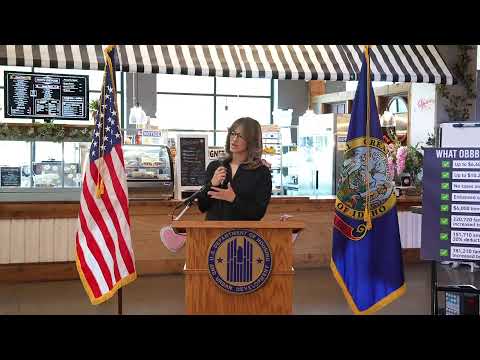
Twin Falls — Federal and state officials and local business owners onstage at Second South Market described opportunity zones and a recently promoted federal tax-and-spending package as key tools to revive rural downtowns and spur private investment.
HUD Secretary Scott Turner, introduced at the event, framed opportunity zones as a targeted tool created under the Tax Cuts and Jobs Act (TCJA) to channel private capital into distressed urban, rural and tribal census tracts. “We’re standing in the opportunity zone right now,” Turner said, praising the Second South Market renovation as an example of private investment meeting local vision.
Turner and other speakers offered program-level outcomes during their remarks. Turner said opportunity zones have attracted “almost $90,000,000,000” in private investment and attributed to the policy the creation of “300,000 units of new housing” and lifting “1,000,000 people … out of poverty.” He presented those numbers as evidence of the policy’s impact on housing and jobs.
Senate and state officials tied those program claims to broader federal legislation. A speaker at the event repeatedly referred to a package he called the “1 big beautiful bill,” arguing it extended key TCJA provisions and would prevent tax increases for many households. He said, as part of his pitch, that extending TCJA provisions preserved roughly $2,400 in annual tax savings for the average Idaho household and that the legislation would reduce the deficit by about $366 billion under the assumptions he described. He also cited permanent business tax provisions, including a maintained 20% deduction for many small businesses and an enhanced standard deduction for some filers.
Kelly Anton, identified at the event as the Idaho Senate president pro tempore, described several Idaho projects that used federal tools to finance expansion. He said Pipeline Plastics, Premier Technologies and Capital Distributing all relied in part on New Markets Tax Credits (a related federal incentive) to build or expand facilities and create both construction and permanent jobs in the region.
Local owners of the Second South Market, Dave and Lisa Budicker, detailed how opportunity-zone investment rules made their project possible after a commercial property sale generated capital gains. Lisa Budicker said the couple purchased and renovated a historic single‑story Salvation Army building and now host seven small vendor businesses and nearly 80 employees. “We are grateful for your partnership with us,” she said, crediting the federal financing tool for turning a modest local investment into a larger community resource.
A business manager who spoke described the venue as a community cornerstone and highlighted a federal provision referenced at the event that was presented as providing up to $25,000 of tax relief for tipped employees; the manager said the change offers practical relief for service workers and helps the local hospitality economy.
What happened next: speakers called on local officials to review zoning and other regulations they said constrain housing production; HUD and state officials said they would continue to work with local leaders to expand housing supply and private investment.
Reporting notes and limits: speakers’ large quantitative claims (for example, the $90 billion investment figure, the 300,000 housing-unit count, and the asserted 1,000,000 people lifted out of poverty) were stated onstage and are reported here as those speakers’ assertions. The event record does not include a separate verification of those specific tallies.
The event concluded with thanks to local hosts and a reiteration from speakers that pairing federal incentives with local planning can accelerate downtown redevelopment and job creation.