Get Full Government Meeting Transcripts, Videos, & Alerts Forever!
Get email alerts on the Sovereignty Ticket topic
No spam. Unsubscribe anytime.
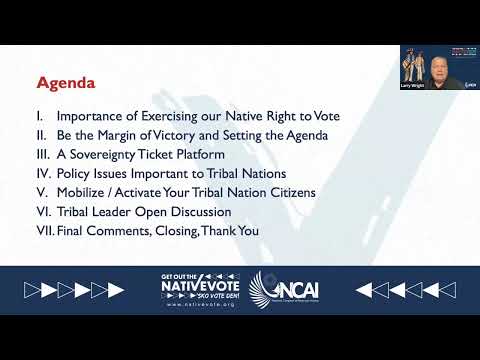
NCAI outlines 'sovereignty ticket' priorities, presses for mandatory funding and expanded Indian health resources
Summary
NCAI executives described a sovereignty-ticket platform for candidates and urged shifting federal Indian funding from discretionary to mandatory appropriations, citing a large infrastructure backlog for IHS, BIE schools and housing and calling for advanced and stable funding.
National Congress of American Indians leaders on the webinar urged tribal nations to press candidates to adopt a "sovereignty ticket" of priorities and to support structural funding changes to honor treaty and trust obligations.
"If you vote in favor of candidates who have a platform supporting the treaty and trust obligation, you strengthen our sovereignty," Larry Wright Jr., executive director of NCAI, said. Wright said NCAI is updating a platform that originated in the White House Tribal Nations Conference and plans to share it with candidates across parties.
Wright argued that many federal Indian programs should be moved from discretionary to mandatory or advanced appropriations so they are not subject to annual budget uncertainty or sequestration. He cited Congress' December 2022 decision to provide advanced appropriations for the Indian Health Service as an example of what persistent advocacy can achieve.
Wright and other presenters described a previously reported Indian-country infrastructure backlog they estimated at roughly $47.8 billion, with needs spanning IHS facilities, sanitation, Bureau of Indian Education (BIE) schools and Indian housing. "Moving Indian country from discretionary to mandatory and forward funded will truly honor the treaty and trust obligations," Wright said.
Dr. Paiment reviewed public-health disparities cited in federal reports and Centers for Disease Control data — higher infant mortality, substance-use and suicide rates among American Indian and Alaska Native populations — and said policy changes such as an IHS portability model and expanded Medicaid/ACA eligibility could increase third-party revenue for IHS and help close the funding gap.
The webinar also included legal and jurisdictional context: presenters noted recent court decisions and continuing threats to tribal jurisdiction, and said NCAI monitors litigation and works with partners to defend sovereignty.
Next steps: NCAI said it will publish the updated sovereignty-ticket platform soon and encourage tribal leaders to use it when asking candidates about consultation, health funding, infrastructure and jurisdictional protections.