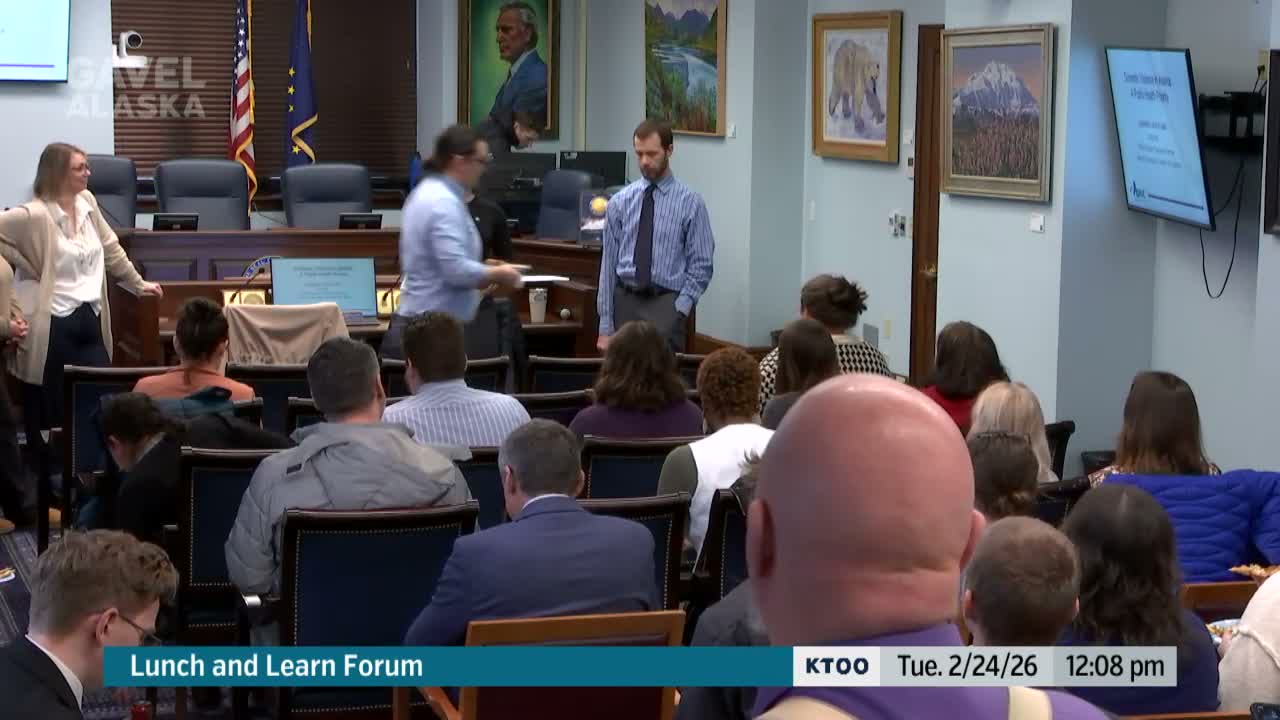
AWAKE leaders say domestic violence is a public‑health crisis in Alaska, cite high rates and rural barriers
Loading...
Summary
Randy Breger, executive director of AWAKE, and Amanda Valenzuela, director of programs, told a lunchtime audience that Alaska has among the nation’s highest rates of intimate‑partner violence, that rural and Alaska Native communities face acute barriers to services, and that prevention offers measurable cost savings.
Randy Breger, executive director of AWAKE (Abused Women Aid in Crisis), and Amanda Valenzuela, AWAKE’s director of programs, framed domestic violence in Alaska as a public‑health crisis during a lunchtime presentation.
Breger said the state’s statutes do not create a single crime called “domestic assault”; instead, criminal charges are filed under standard crimes (for example, assault in the fourth degree) and an accompanying checkbox flags an incident as involving domestic violence, which then triggers statutorily required responses by police, prosecutors and courts. Breger argued that understanding domestic violence as a public‑health issue — not only a legal one — highlights long‑term health consequences and system costs.
Valenzuela described AWAKE’s services, saying the organization runs a 67‑bed locked shelter and a 10‑bed transitional housing program called Harmony House that offers 18–24 month stays. She said AWAKE provides legal advocacy, case management and nonresidential services and that more than half of AWAKE’s staff have lived experience as survivors.
Both speakers presented prevalence and health data. Valenzuela cited national slide figures that about 41% of women experience physical violence, stalking or intimate‑partner violence in their lifetimes and that roughly 16,000,000 women reported first experiencing IPV before age 18. The presenters said Alaska’s rates are higher than the national average; Valenzuela stated “nearly 60 percent of all women in Alaska” have experienced some form of domestic violence, and Breger emphasized that many of the most severe harms — including homicide — are committed by people the victim knows.
Breger highlighted a chart showing that about 94% of homicides of women, where relationship is known, were committed by current or former intimate partners or close acquaintances. He contrasted that with male homicide victims, who are more often killed by strangers, and said the difference helps explain greater lethality and severe injury among female victims.
Both speakers linked childhood exposure to domestic violence with long‑term health outcomes. Valenzuela explained adverse childhood experiences (ACEs) and said higher ACE scores are associated with chronic disease, mental‑health problems and behavioral outcomes that perpetuate cycles of violence. Valenzuela also shared a personal account of becoming pregnant during an abusive relationship: she said she was kicked in the abdomen at about 32 weeks, required an emergency C‑section and gave birth prematurely to a child who had ongoing health issues — an example the presenters used to illustrate intergenerational health impacts.
The presenters described efforts to preserve stability for children, including AWAKE’s partnership with the Anchorage School District’s Child in Transition program to keep children in their home schools where safe. Breger said using staff with lived experience helps design effective interventions and programming.
On costs, Breger cited an estimate of $3.6 trillion in lifetime U.S. costs associated with IPV (injuries, lost productivity and criminal‑justice expenses). He said preventing just 100 cases of domestic violence in Alaska would avoid about $10,000,000 in lifetime costs, framing prevention as both a human‑services and fiscal priority.
An audience member asked about proactive outreach to rural and Alaska Native communities; Breger responded that Anchorage functions as a service hub, that many rural residents relocate to Anchorage for safety and services, and that AWAKE partners with tribal health organizations including the Alaska Native Tribal Health Consortium (ANTHC), Cook Inlet Tribal Council and Southcentral Foundation to provide culturally informed services.
Breger and Valenzuela urged attendees to consider prevention investments and to use survivor‑informed program design; they offered to remain after the session for private follow‑up questions.
The presenters’ direct statements and program details above are drawn from the presentation given by AWAKE staff during the recorded session.