Get AI Briefings, Transcripts & Alerts on Local & National Government Meetings — Forever.
Subcommittee hears juvenile-justice budget; Medicaid activation before release highlighted
Summary
The House Finance subcommittee heard the Division of Juvenile Justice’s FY27 request and was told of a new Medicaid activation process that enrolls justice-involved youth before release to ensure immediate access to services, alongside staffing gains at McLaughlin Youth Center and restored occupational-therapy contracts.
The Alaska House Finance subcommittee on Family and Community Services received a high-level FY27 operating budget overview from the Division of Juvenile Justice on Thursday, with director Matt Davidson stressing program changes designed to smooth transitions out of custody.
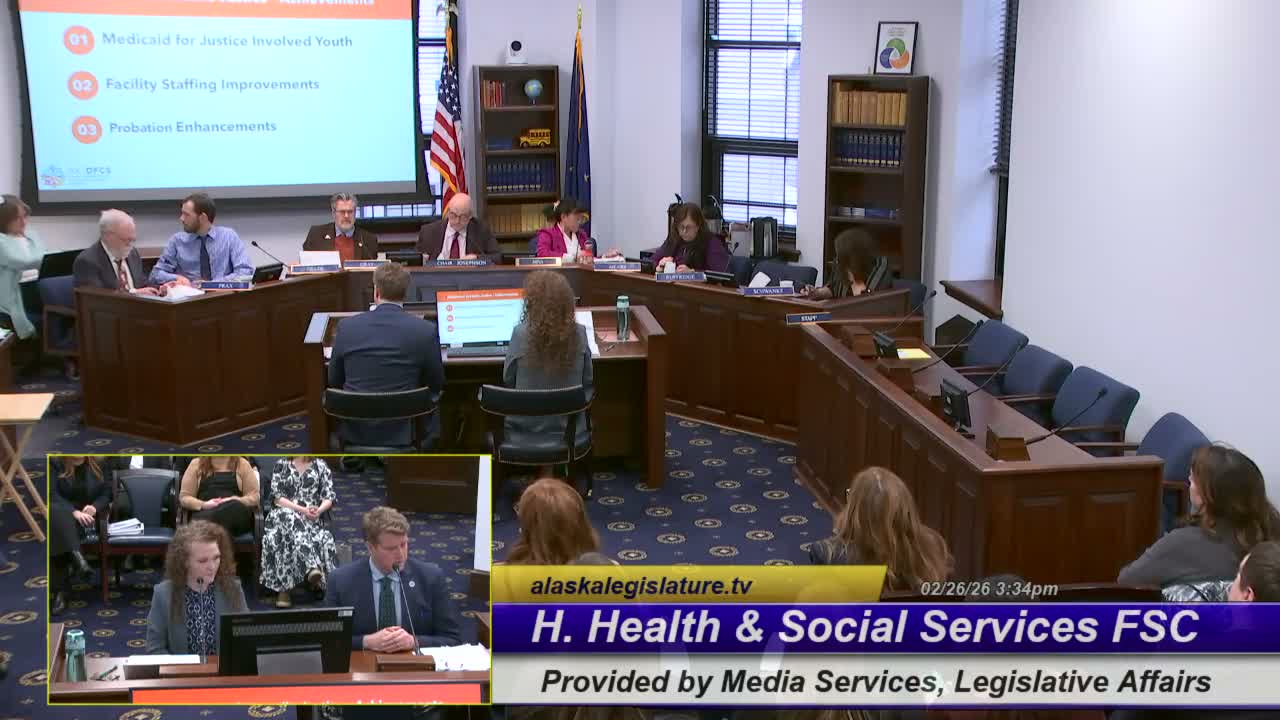
"This is a really big, subtle, but big move," Davidson said of a Medicaid-for-justice-involved-youth partnership with the Department of Health that allows limited Medicaid services for youth during the final 30 days of a DJJ stay and for 30 days after release. The change, he said, ensures Medicaid is activated before youth leave custody so they can immediately access community providers.
The proposed DJJ budget totals roughly $73,000,000.06 and funds facilities, 13 probation offices and 421 full-time positions. Davidson told the subcommittee DJJ currently has about 150 youth in custody across six facilities and about 500 youth under some form of community supervision statewide.
Davidson pointed to staffing improvements at McLaughlin Youth Center, the division’s largest facility, saying vacancies there have fallen to two of roughly 100 juvenile justice counselor positions. He said staffing remains a concern in Juneau and Fairbanks but that recruitment and retention steps are improving the workforce picture.
On programming, Marion Sweet, DFCS assistant commissioner, said the division recently started a contract with a licensed occupational-therapy contractor and has positions in Anchorage and Juneau to provide those services at specialized neurobehavioral programs in Bethel and Fairbanks. Sweet also described interagency receipt authority arrangements with Education and Labor for nutrition and WIOA youth programs and mental health trust funding used to support occupational services.
Committee members probed the history of a proposed Fairbanks youth court and the disposition of FY26 budget items. Davidson said the Fairbanks youth court proposal "didn't make it through conference committee" and the division will follow up with historical details.
What’s next: The subcommittee will receive updated budget action reports prior to March 3 closing votes; DJJ staff committed to provide requested follow-up data on youth-court history and details about community supervision counts.