Get Full Government Meeting Transcripts, Videos, & Alerts Forever!
Get email alerts on the Isotope Production topic
No spam. Unsubscribe anytime.
Speakers describe Oak Ridge HFIR as vital source of rare isotopes for medicine, security and materials research
Summary
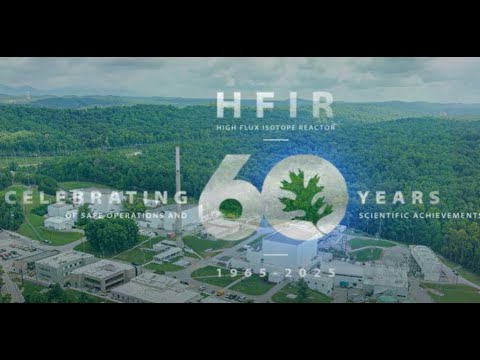
In a recorded presentation, unidentified speakers called the High Flux Isotope Reactor (HFIR) at Oak Ridge National Laboratory a "national treasure," stressing its role producing rare isotopes (including californium-252 and nickel-63) used for healthcare, national security and materials science.
In a recorded presentation, unidentified presenters described the High Flux Isotope Reactor (HFIR) at Oak Ridge National Laboratory as essential infrastructure for producing rare isotopes and enabling materials research. "HIFER is, the facility is a national treasure, it really is," said Speaker 1 in the transcript, praising the reactor's societal benefits.
Speakers said HFIR supports isotope production used in industry and medicine, materials exploration, criminal forensics and security. "HFIR is the majority supplier in the Western world," Speaker 5 said, citing the reactor's role supplying some isotopes that the speakers said can be produced at only two sites worldwide. The transcript names two isotopes (spoken as "californium 2 52" and "nickel 63"); these refer to californium-252 and nickel-63, which the presenters linked to uses in energy, national and homeland security, and healthcare.
Presenters also framed HFIR's research value beyond isotope production. Speaker 2 noted that reactors provide access to particles not available elsewhere and invoked the Manhattan Project when describing reactors' historical importance. They said neutron probes enable study of materials needed for advanced computing and suggested the facility's instrumentation can help researchers investigating biological structures: "If you wanna understand Alzheimer's better, we need to understand how proteins work," Speaker 2 said, arguing neutrons can reveal details of protein structure.
Several speakers emphasized operational excellence and continuity. Speaker 3 called HFIR "a culture of world class excellence in operations and science that we operate safely," and Speaker 4 said it is crucial that the reactor continue to operate because it supports multiple national needs, including applications ranging from medical sectors to geological exploration and even spaceflight.
The transcript contains inconsistent facility names and likely transcription errors. The presenters used variants including "HIFER," "HYPER" and "HyFlux Isotope Reactor"; the correct facility name is the High Flux Isotope Reactor (HFIR) at Oak Ridge National Laboratory. The transcript also uses the word "oxytocin" when discussing airport security and production, a term that appears inconsistent with the surrounding discussion about isotopes and is likely a transcription error.
No formal votes, motions or policy decisions appear in the provided transcript. The remarks in the recording were statements in favor of continued HFIR operation and emphasized the facility's scientific and practical contributions.