Lifetime Citizen Portal Access — AI Briefings, Alerts & Unlimited Follows
Delta Regional Authority guidance: How to prepare Work Round 6 applications
Loading...
Summary
A DRA consultant outlines the required forms, narrative structure, attachments, partner commitments, scoring breakdown, and the June 20, 2024 grants.gov deadline for Work Round 6 applications. Key technical requirements include the SF-424/SF-424A, a 20-page narrative limit, and a $15/hour minimum pay expectation for funded jobs.
Nicole Dunn, a consultant with Chamberlain Dunn LLC, walked applicants through the required components for Work Round 6 applications to the Delta Regional Authority, emphasizing strict formatting, partner commitments, measurable results and the application deadline.
Dunn said applicants must submit the SF-424 (Application for Federal Assistance) via grants.gov (the FOA lists the link on page 16), and she urged applicants to use the most recent version of the form. "You will need to have an authorized representative sign it and you will need to make sure you are registered with SAM.gov," she said, adding that organizations should begin UEI/SAM and grants.gov registrations immediately if they have not already.
The project budget must include the SF-424A budget information form and a budget narrative that follows the SF-424A categories. Dunn advised applicants to reconcile all budget totals across the SF-424, SF-424A, the budget narrative and any other places the figure appears, and to prepare budgets in spreadsheet software before entering final numbers to avoid arithmetic errors.
"The project narrative is the meat of the application," Dunn said. The narrative is limited to 20 single-sided, double-spaced letter-sized pages in Times New Roman 12 with 1-inch margins; reviewers will not read material beyond that limit. The budget narrative does not count toward the 20-page limit. Dunn strongly recommended that applicants label subsections so reviewers can quickly verify that the FOA's required components and the three FOA focus areas are addressed.
The narrative contains four sections: the statement of need (worth 20 points), project results (30 points), project design (42% of points overall, including 32 points for project description and 10 for partnerships), and organizational capacity (4 points). Dunn provided a granular breakdown of points within project description: 18 for project overview, 6 for project description tied to focus area 1, and 4 points each for focus areas 2 and 3. Reviewers score each requirement as "full," "partially met" (half points) or "failed" (0).
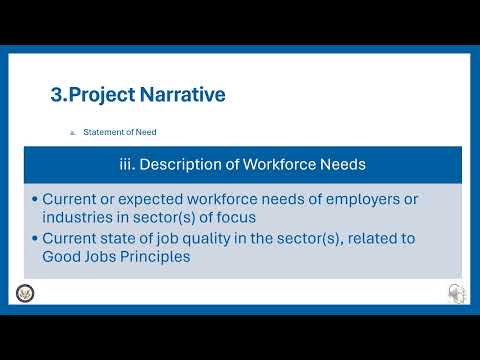
For the statement of need, applicants must describe the service area and challenges with verifiable data (for example, wages and workforce demographics) and explain industry sector choices. Dunn noted applicants may use the Climate and Economic Justice Screening Tool as one data source. The statement of need also requires applicants to identify target populations (historically marginalized groups) and explain recruitment plans; the populations chosen in the application are binding during implementation and cannot be expanded without modification.
Dunn reviewed the FOA’s eight "good jobs" principles (recruitment and hiring; benefits; diversity, equity, inclusion and accessibility; empowerment and representation; job security and working conditions; organizational culture; pay; and skills and career advancement). On pay, she said Work Round 6 emphasizes a minimum of $15 per hour (before overtime, tips and commissions), plus transparent advancement pathways and employer-supported training.
The project description must explain project activities and how those activities produce the stated outputs and outcomes; activities should be represented in the project timeline and align to the budget narrative. Applicants must document committed partners: at least two employer/industry representatives, one state or local workforce development agency (unless the applicant itself is a workforce agency), and one community organization (unless the applicant itself is a community organization). Evidence of commitment (letters of commitment, MOUs) should be included in attachments and must match narrative descriptions.
Required attachments include: an abstract (up to two pages containing 12 items), an indirect cost rate agreement (if applicable), a financial system risk assessment, evidence of required partners (which affects scoring), a project timeline (which affects scoring), and key staff experience and job descriptions (which affect scoring). Dunn underscored that some attachments affect scoring while others do not.
Dunn closed with practical application tips, including copying FOA headings into a working document and preserving FOA language in comment bubbles to avoid accidentally removing required content during internal edits. She directed applicants to the FOA for specific templates and contact information for technical questions, and reminded viewers that applications are due Thursday, June 20, 2024, at 11:59 p.m. Eastern and must be submitted through grants.gov.
"Best of luck on your application," she said, and provided her contact as nd@chamberlaindunn.com for follow-up questions.