Lifetime Citizen Portal Access — AI Briefings, Alerts & Unlimited Follows
DRA consultant outlines how to write the Statement of Need for Round 6 workforce grants
Loading...
Summary
Nicole Dunn of Chamberlain Dunn LLC advises applicants that the Statement of Need is 20 of 100 points for Delta Regional Authority Round 6 Work Initiative grants and must clearly tie community challenges, target populations and workforce needs to proposed activities; she also lists format rules, data sources, and the 06/20/2024 Grants.gov deadline.
Nicole Dunn, a consultant with Chamberlain Dunn LLC, detailed how applicants should craft the Statement of Need for the Delta Regional Authority’s (DRA) Work Initiative Round 6 application, stressing that the section is a heavily weighted part of the review. “It's a fifth of your points, 20 out of a 100,” Dunn said, and advised applicants to show clearly why their project is necessary and how it aligns with the initiative’s goals.
The Statement of Need is one of four required parts of the project narrative (the others are project results, project design and organizational capacity). Dunn said the project narrative is limited to 20 single-sided, double-spaced pages in Times New Roman 12 with 1‑inch margins, and that reviewers will not read material beyond that limit; she noted the budget narrative is not included in the 20‑page count.
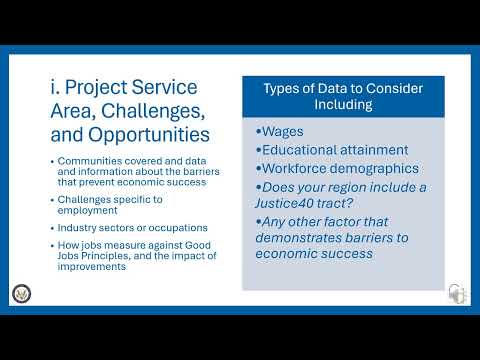
Dunn broke the Statement of Need into three scored subsections and the points assigned to each: project service area, challenges and opportunities (8 points); target population (6 points); and description of workforce needs (6 points). She advised applicants to label each subsection to mirror the Funding Opportunity Announcement (FOA) and to use FOA language so reviewers can readily verify alignment with the program’s three focus areas.
On describing place and need, Dunn recommended including concise, verifiable indicators such as wages, educational attainment and workforce demographics and pointed applicants to the FOA’s links to the Climate and Economic Justice Screening Tool as a suggested source. “You need to include enough detail that a prudent reviewer could reasonably know where your data came from,” she said.
For job‑quality assessment, Dunn summarized the FOA’s eight “good jobs” principles applicants should use to evaluate the quality of occupations they target: recruitment and hiring, benefits, diversity/equity/inclusion and accessibility (DEIA), empowerment and representation, job security and working conditions, organizational culture, pay (the FOA lists a $15 per hour target), and skills and career advancement.
On target populations, Dunn walked applicants through the FOA’s three eligibility categories — new entrants, dislocated workers and incumbent workers — and warned that selecting categories in the application constrains who the applicant may serve without an approved scope modification. She recommended explaining why prioritized populations were chosen and how recruitment and retention will be achieved.
Dunn urged applicants to use both quantitative labor market information and qualitative evidence (for example, employer testimonials and partner reports) to describe employer needs and job quality in targeted sectors. Suggested data sources included the FOA’s linked screening tool, local and state planning documents, state labor exchanges, statsamerica.org, data.census.gov, Census Reporter, county health rankings and Bureau of Labor Statistics data.
On competitiveness, Dunn advised applicants to prioritize persuasive data, eliminate redundancy, tailor analysis to the specific region/industry and make explicit links from the Statement of Need to project design and expected results. While the FOA does not require a formal logic model, she recommended sketching a simple internal model that connects needs, goals, activities, resources and results to demonstrate planning and capacity.
Applicants were reminded to begin required registrations now (UEI, SAM.gov and Grants.gov). Dunn reiterated submission rules: applications must be submitted electronically through Grants.gov by Thursday, 06/20/2024 at 11:59 p.m. Eastern. She provided a contact route for technical questions via the FOA and read an intended DOL contact address that appears garbled in the transcript; her own contact was clear: nd@chamberlaindunn.com.
The video is part of a DRA series of technical‑assistance resources for Round 6 applicants and is intended to help applicants present verifiable need, align proposed activities to the FOA’s focus areas, and maximize competitiveness under the stated scoring criteria.