
Board adds proactive regulatory priorities — AI, psychedelic‑assisted therapy and paraprofessionals among topics
Get AI-powered insights, summaries, and transcripts
Sign Up Free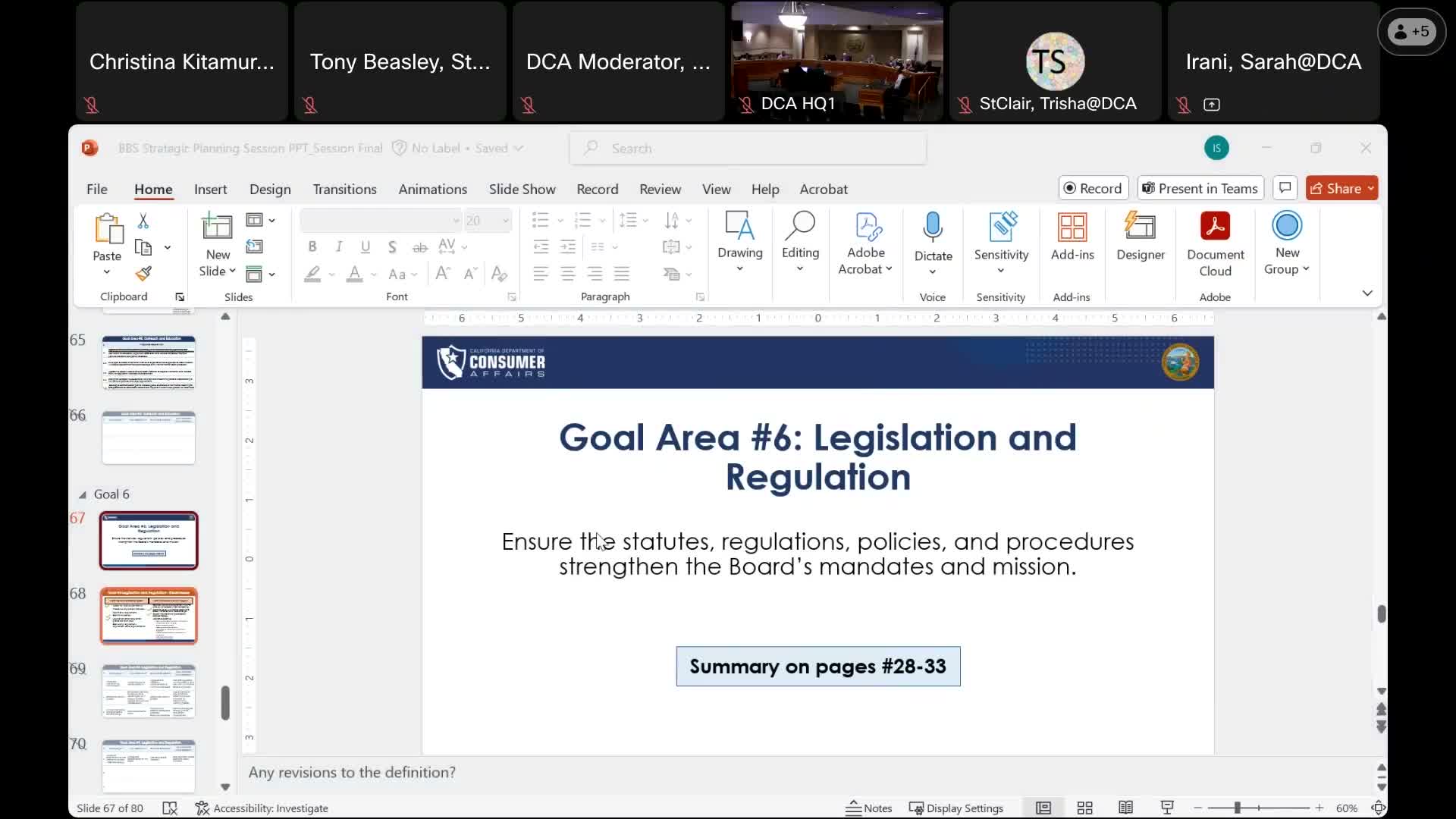
Summary
Members pressed staff to make legislation and regulation objectives more proactive, explicitly naming AI in therapy, psychedelic‑assisted therapy, uniform standards review (Senate Bill 1441), license portability/compacts and the growing paraprofessional/coach sector as items to track and, where appropriate, pursue via regulation or legislative proposals.
The board discussed Goal Area 6 (Legislation and Regulation) and urged staff to capture proactive priorities rather than only reactive regulatory housekeeping.
Members recommended explicitly listing high‑interest topics — including regulation of artificial intelligence used in therapy, standards for psychedelic‑assisted therapy, a review of the Uniform Standards Act (Senate Bill 1441/Ridley‑Thomas Act) that governs substance‑abuse‑related license conditions, and license portability/compacts — rather than leaving them as unspecified tasks. Staff said those items can be included as task items and tracked in the plan; some members favored naming them as objectives so they are visible and auditable in the four‑year plan.
The board also discussed the rise of non‑licensed paraprofessionals and wellness/life coaches who market therapeutic services. Members suggested two parallel approaches: (1) outreach/education to clarify boundaries between coaching and licensed therapy, and (2) evaluate whether some paraprofessional roles should be regulated or coordinated with other state agencies (for example, HCAI or other certifying bodies). Several members emphasized the need to strike a balance between a compact, living strategic plan and naming concrete legislative/regulatory targets the board will monitor or pursue.
"We should be proactive and mention these particular things because they're on people's minds," a board member said when urging inclusion of AI and psychedelic therapy in objectives. Staff will refine the draft to break some broad items into discrete objectives or tasks and to propose a mechanism for adding emerging legislative priorities to the plan with board approval.