Get Full Government Meeting Transcripts, Videos, & Alerts Forever!
Get email alerts on the School Safety topic
No spam. Unsubscribe anytime.
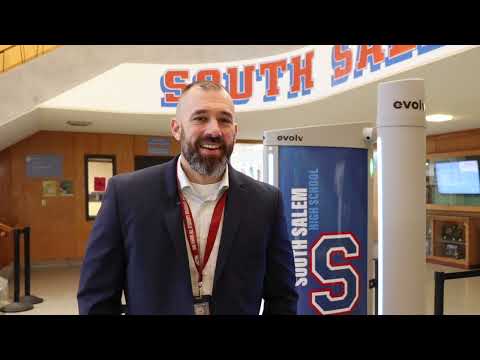
Salem-Keizer safety director outlines layered plan and new weapons-detection screening for all students and guests
Summary
Chris Baldridge, the district's director of safety and risk management services, described a layered approach that includes a 'digital fence,' door alarms, vinyl window wraps and adjustable weapons-detection systems that students and visitors will be required to pass through; alerts will prompt quick campus-safety checks.
Chris Baldridge, the director of safety and risk management services for Salem Keizer Public Schools, described a districtwide, layered approach to school safety that will require all students and guests to pass through newly installed screening systems.
"District's approach to safety is in layers," Baldridge said, using a "slice of Swiss cheese" metaphor to explain why the district is stacking multiple protections to cover gaps in any single measure. He identified a combination of physical and technological measures intended to control who enters and exits school buildings.
Baldridge described the district's "digital fence," a set of technologies to limit the number of doors students and visitors can use so staff can see and screen people entering schools. He said alarms will be active on those doors during the school day and that vinyl wraps — a perforated film that allows students to see out but keeps the interior from being visible from outside — will reduce informal admissions through unsecured points.
On detection technology, Baldridge distinguished the systems the district is deploying from standard metal detectors. "The biggest difference between your standardized metal detector and what we're deploying in Salem Keizer schools is the ability that they are adjustable, and that they're actually incorporating technology where they're looking for items," he said, adding that the systems can "recognize shapes" and are analyzed to detect firearms and explosives.
"All students and guests are gonna be required to go through our systems," Baldridge said, acknowledging that people may feel some initial anxiety but saying the process should become smoother with time. He said campus-safety staff will be positioned to greet people and assist users through the system.
When a system alert occurs, Baldridge said the individual will be moved to a station to meet with a campus-safety professional. If the alert indicates an item in a bag, staff will take and inspect the bag; if the alert is on a person, staff may ask them to pat down a waistband or pull contents from a pocket for inspection. He characterized these follow-ups as "very, unintrusive" and quick, focused on locating firearms, knives and other contraband.
Baldridge framed the detectors as a necessary response to incidents in the community and said the district chose systems meant to minimize disruption to student experience: "We selected the system because we didn't want to change your student experience. And if we changed it, we minimally changed it." He closed by saying students should be able to get through entry points "with reasonable ease" and return to class confident they are safe.
The presentation outlined operational details about screening and follow-up checks but did not specify implementation timelines, exact locations for installations, vendor names, or costs. Those details were not specified in the remarks.