Lifetime Citizen Portal Access — AI Briefings, Alerts & Unlimited Follows
Wooster High hosts College Credit Plus information session; schools outline eligibility, deadlines and student responsibilities
Loading...
Summary
School counselors and representatives from Ashland University, Ohio State ATI, Stark State and Wayne College described Ohio's College Credit Plus dual-enrollment program, key deadlines (April 1/13, April 15, May 1, Oct. 15), credit limits, transcript consequences, FERPA/info-release rules, and an AU scholarship opportunity.
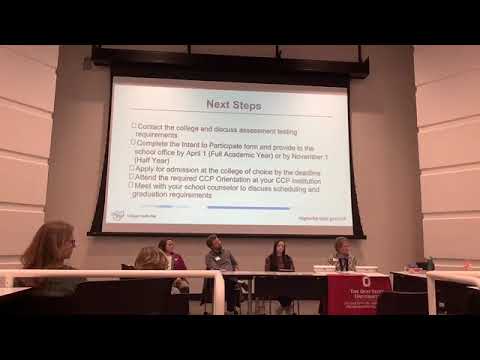
Wooster High School hosted an information session explaining Ohio's College Credit Plus (CCP) dual-enrollment program, with school counselors and representatives from Ashland University, Ohio State ATI, Stark State and Wayne College outlining how students apply, eligibility rules, and important deadlines.
The session opened with Tyler Egley, a school counselor at Wooster High School, who described CCP as "a dual enrollment program" that lets students earn college credit that appears on both their high school and college transcripts and counts toward GPA. Egley said most Wooster students begin CCP in 10th'12th grade and that classes may be taught on-site by properly credentialed Wooster teachers or taken online through partner institutions.
Counselors and college representatives detailed eligibility and application steps. Presenters said students generally must show college readiness through ACT/SAT remediation-free scores or an acceptable unweighted GPA; each college requires its own application and may set additional criteria. Egley and other presenters emphasized counselors' role in sending official high school transcripts after students apply.
Presenters described limits and consequences. A presenter explained that Level 1 courses consist of the first 15 transferable credits and listed non-allowable options (private applied courses, study-abroad, physical education, pass/fail, remedial or religious courses). "A student can take up to 30 credits per year," a presenter said, adding that students who enroll in more than 30 credits must either drop a course before the no-fault withdrawal date or pay college-standard rates. Kelsey Donahoe warned that failing or withdrawal-failing courses may require family reimbursement and could put a student on CCP probation (for example, a term GPA under 2.0 or two or more withdrawals), and she noted academic outcomes on a college transcript can affect future financial aid.
Athletic eligibility and privacy were also stressed. Donahoe said athletes must be passing five courses to maintain eligibility. Ryan Palmer of Stark State cautioned families to use a personal email account rather than a Wooster High School address for college communications and explained a college information-release form that must be signed for parents to receive students' academic records: "We have to treat their private information the exact same as every other student that goes to the college," Palmer said.
College-specific details and deadlines varied. Heather McKay of Ashland University said one AU CCP course can qualify a student for an AU scholarship that pays "$500 every semester stackable to $4,000" for students who attend AU after high school; she outlined an April 1 application deadline and an April 13 fall registration window. Jill Byers of Ohio State ATI described admission options (a recalculated 3.0 GPA with specific course requirements or test scores) and noted Ohio State's Accuplacer may need to be taken on the ATI campus; she cited a May 1 deadline for full-year admission and an Oct. 15 deadline for spring-only applications and invited families to an ATI CCP night on March 5. Sarah Winstead Stead from Wayne College (University of Akron) reiterated that Wayne is test-optional, requires a signed permission page (student, parent/guardian, and school counselor) and set an April 15 deadline for summer/fall '26 applications.
Presenters pointed families to online resources for transferability and course planning (transfercredit.ohio.gov, Transferology) and advised students to keep course syllabi if they plan to transfer credits to out-of-state institutions. Counselors said they will post the presentation on the school's website and will meet individually with students next week to distribute packets and assist with applications.
The session closed with Egley noting handouts and counseling appointments will be available Monday; counselors will meet students individually in the library the following week to finalize paperwork and answer questions.