Lifetime Citizen Portal Access — AI Briefings, Alerts & Unlimited Follows
Wooster High staff, college partners outline College Credit Plus rules, deadlines and risks
Loading...
Summary
At an annual Wooster High School College Credit Plus meeting, school staff and enrollment officers from Stark State, Ohio State ATI, University of Akron Wayne College and Ashland University reviewed eligibility rules, the 30-hour funding cap, transferability limits and application deadlines.
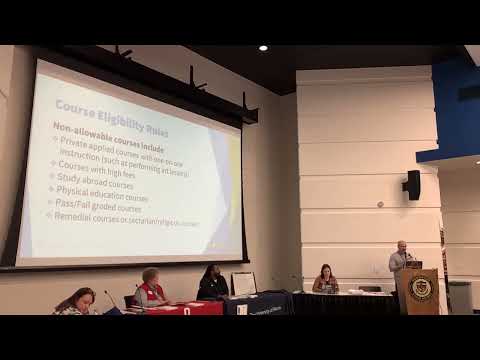
A Wooster High School staff member opened the annual College Credit Plus (CCP) meeting and walked families through how students in grades 7–12 can earn college credit while still enrolled in high school. The session included presentations from representatives of Ashland University, the University of Akron Wayne College, Ohio State ATI and Stark State College and concluded with a question-and-answer period.
The presenter said CCP courses ‘‘count as high school credit and as college credit’’ and stressed that acceptance to each university is required to obtain the college credit. She said eligibility standards are set by the university and the state and commonly include remediation-free test scores (ACT or Accuplacer) and an unweighted GPA around 3.0, though colleges may accept course grades or testing alternatives.
Why it matters: CCP can accelerate a student’s college progress and reduce first-year tuition costs, but it also carries academic and financial risks if a student performs poorly. The presenter warned that ‘‘if you fail a class, then you have to pay for the class, and also that goes on to your transcript, and you can’t recover that class.’’ Families were urged to weigh maturity, time management and course difficulty when deciding to enroll.
Key deadlines and options highlighted at the meeting included an April 1 intent/permission form the high school requires each year to participate; Ashland University’s fall application deadline of June 15 (staff recommended applying by April 1 for early registration); University of Akron Wayne College’s April 15 deadline for fall starts; Ohio State ATI’s May 1 application deadline; and Stark State’s flexible approach to late applications. The presenter summarized the funding rule as ‘‘the magic number is 30 hours per year’’ for state-funded CCP enrollments and clarified that summer sessions count toward that limit.
College partners described specific admissions rules. Robert Harris, assistant director of admissions at University of Akron Wayne College, said Wayne favors a 3.0 cumulative unweighted GPA or remediation-free scores and recommends students submit ACT scores; he noted an April 15 deadline for fall admissions. Jill Byers of Ohio State ATI reiterated a 3.0 academic GPA path or testing and added that ATI requires Accuplacer scores taken at an Ohio State campus to use that test for admission; she listed May 1 as ATI’s application deadline. Wendy Pisoni of Stark State said Stark State had about 4,296 CCP students in spring and emphasized that the college accepts scores from other institutions and will work with applicants who apply after posted deadlines.
The presenter explained two enrollment options: Option A allows students to self-pay to avoid a college grade appearing on the high school transcript; Option B (the default) has the school system pay for up to 30 hours per year. She clarified that CCP funding covers an entire class, not a single hour, so students who exceed the 30-hour annual cap are responsible for the full cost of the excess course.
On transferability, the presenter cautioned that while credits commonly transfer between public institutions, grades typically do not transfer unless a student later enrolls at the same university that assigned the grade. Families were directed to transfercredit.ohio.gov for course-transfer guidance.
The meeting closed with reminders to submit the intent/permission form by April 1 (nonbinding) and to meet with guidance counselors for help with application steps and credit calculations.