Get Full Government Meeting Transcripts, Videos, & Alerts Forever!
Get email alerts on the Tribal History And Identity topic
No spam. Unsubscribe anytime.
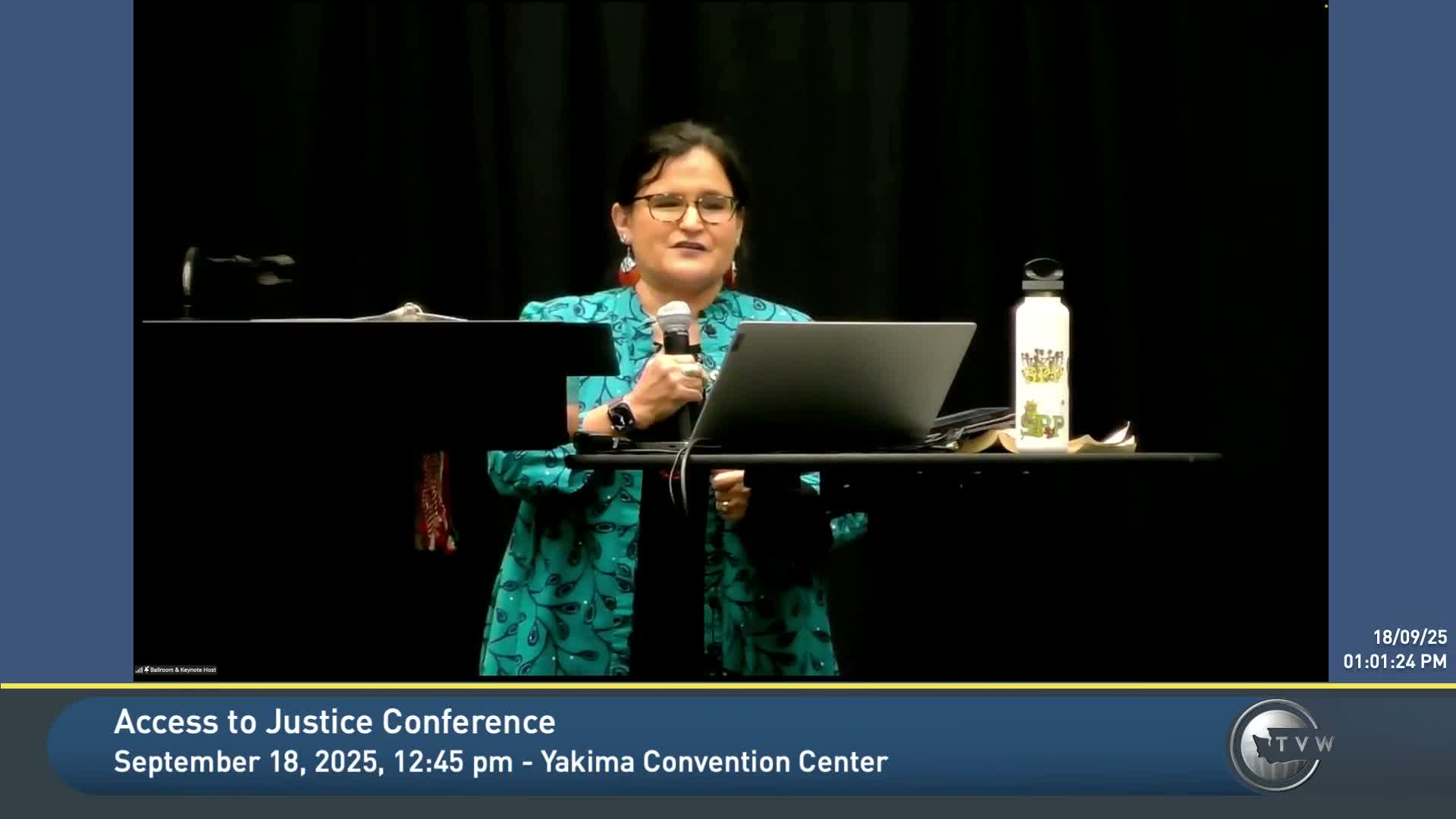
Justice Raquel Montoya-Lewis recounts family boarding-school history and warns against praising 'resilience' as a solution
Summary
Washington State Supreme Court Justice Raquel Montoya-Lewis used a keynote to recount family history of Carlisle boarding schools, describe tribal disenrollment that cost her land and membership, and argue that labeling communities 'resilient' can obscure responsibility for systemic harms.
Justice Raquel Montoya-Lewis, an associate justice of the Washington State Supreme Court, told a packed keynote that stories of enforced assimilation, tribal disenrollment and unacknowledged grief shape how Native people should be discussed and served.
Montoya-Lewis began by asking the audience to rethink familiar words such as hope and resilience, saying she would offer “some alternatives to some of the standard kinds of ways we talk about many of the communities and the people that we serve.” She said an exclusive focus on optimism can take attention away from present harms and that hope and fear can be “two sides of the same feeling.”
Much of the keynote recounted family history. Montoya-Lewis presented archival photographs and family letters showing relatives from the Pueblo of Laguna who were taken to the Carlisle Boarding School in Pennsylvania in the late 19th century. She said the photographs show a “before” in traditional clothing and an “after” in Western dress or military uniform, and quoted the boarding-school motto she described as emblematic of the era: “kill the Indian, save the man.”
“The children were taken without their permission,” Montoya-Lewis said, describing trains that carried pupils across the country and the lasting sadness recorded in the school’s documentation. She noted that one great-aunt “didn’t return” and was buried at the Carlisle Cemetery.
Montoya-Lewis also described discovering family records — including a “certificate of Indian blood” and a Pueblo membership report — that illuminated how tribal enrollment and federal documentation have determined people’s legal status. She said her service as a tribal court judge ended after a disputed election and an ex parte meeting in which she was pressured to dismiss a case; she said she refused and was later disenrolled, which she said cost her the right to own the family land she had been living on.
“Being told very directly, you’re not one of us. You don’t belong here,” she said of the disenrollment meeting, describing the practical consequences of losing membership.
Throughout the speech, Montoya-Lewis challenged the common framing that celebrates marginalized groups as inherently “resilient.” She said such praise can be invalidating because it places responsibility for enduring injuries on survivors rather than on institutions that perpetrated harm. “If you describe the communities we’ve oppressed as resilient, then it takes away our responsibility for addressing our side of it when we’re the oppressors,” she said.
She introduced the term “disenfranchised grief,” citing a presentation by Sandy White Hawk at a National Public Defense conference, to describe unresolved grief and trauma that have not been publicly acknowledged and therefore have limited pathways to healing.
Montoya-Lewis also shared personal disclosures: she said she is a late-diagnosed autistic person and described living with invisible disabilities (including a connective-tissue disorder) and the adjustments she made to navigate professional spaces. She framed language preservation and cultural participation as central to how Indigenous people “thrive” and urged the audience to speak about Native people “in the present tense.”
The keynote closed with thanks to her chambers staff and externs and a round of applause from the audience.
Why it matters: Montoya-Lewis is both a sitting state supreme court justice and a public voice on Indigenous history and law. Her account tied personal family records and courtroom experience to broader policy-relevant issues — historical boarding-school practices, tribal governance rules on enrollment, and the social framing of trauma and resilience — that affect policy discussions about reconciliation, cultural preservation and legal recognition.