Get AI Briefings, Transcripts & Alerts on Local & National Government Meetings — Forever.
State Water Boards present updated benthic cyanobacteria guidance, sets 15% percent‑cover posting threshold
Loading...
Summary
California Water Boards staff outlined revised guidance and a field SOP for benthic harmful cyanobacterial mats that prioritizes a 15% percent‑cover visual trigger, a tiered SPATT passive‑sampler approach, and practical sample‑collection and shipping protocols for local monitoring groups.
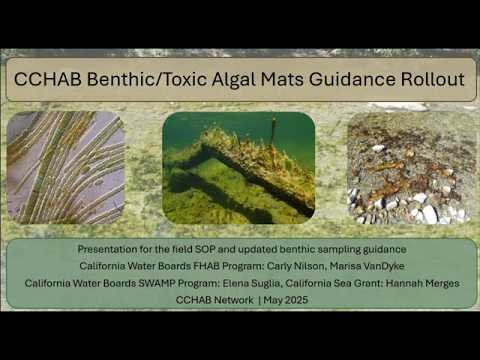
State Water Resources Control Board staff on a May webinar rolled out updated guidance and a field standard operating procedure (SOP) for monitoring benthic harmful cyanobacterial blooms (HCBs), introducing a 15% percent‑cover visual threshold to guide signage postings and a three‑tier monitoring approach that begins with SPATT passive samplers.
Hannah Merges, a state fellow placed with the State Water Resources Control Board’s Office of Information Management and Analysis (SWAMP unit), said the revised guidance aims to standardize monitoring across California and improve the information used to protect people and domestic animals from cyanotoxin exposure. “Anything above that 15% cover is going to trigger a signage posting,” Merges said, describing the percent‑cover metric as a rapid, low‑cost way to prioritize protective action while lab toxin results are pending.
The guidance emphasizes a tiered approach. Tier 1 uses SPATT (solid phase adsorption toxin tracking) bags deployed about four to seven days to detect rising cyanotoxin signals. If SPATT indicates increasing toxins, responders move to tier 2 visual assessments of benthic mat percent cover over a defined sampling reach (up to 150 feet). Tier 3 is collection of a composite mat sample for laboratory toxin analysis and taxonomic identification.
Elena Sullia, an environmental scientist who led the SOP walkthrough, described the field sampling steps: choose a 150‑ft reach focused on likely public‑use areas, conduct a zigzag visual survey (in flowing channels, ponds or shoreline‑appropriate methods), record spatial coverage by dividing the reach into thirds, and collect a composite mat sample composed of roughly 12 small pieces taken from multiple hot spots to capture morphotype diversity. “If you’re sampling in the water…you’ll aim for three pieces of mat material at each location,” Sullia said, explaining that the composite improves representativeness for lab analysis.
The SOP includes practical preservation and shipping guidance: place samples on ice immediately, store at roughly 2–8°C (do not freeze), include a completed chain‑of‑custody in a sealed bag, coordinate with the receiving lab before shipping, ship overnight when possible, and avoid shipping on Fridays or Saturdays; samplers were told the lab hold time for receival is five days. The presenters also recommended prelabeling containers with site code, waterbody and date, and using amber glass jars to reduce light exposure and limit toxin leaching.
Signage guidance links percent‑cover and toxin data to colorized postings: generally, <15% cover with no toxin data allows a green awareness sign; >15% cover typically warrants a yellow toxic‑algae alert; and scenarios with low cover but detected toxins or high toxin signals from SPATT require additional contextual decisions. The guidance recommends monitoring a posted site about biweekly and deposting signs after two consecutive weeks of non‑increasing observations, per the decision framework presented.
Presenters said the updates were informed by North Coast regional board studies and by an extensive literature review; the benthic subcommittee that drafted the revisions began meeting in 2023, circulated a draft in December for review, and presented updates to the broader CCHAB network in January before the current rollout. Merges noted that while percent cover is not a direct measure of toxin concentration, combining visual coverage with SPATT and composite mat analysis produces more protective and repeatable monitoring data.
On program authority and implementation, Carly Nelson (identified earlier by the presenters as an FHAB program lead) said the guidance is voluntary and not regulatory: local monitoring groups may use the decision tree and post signage consistent with the guidance, and the Water Boards ask participants to notify them so postings can be added to the statewide map. Marissa Van Dyke of the Water Boards encouraged groups to report postings and to contact the boards for outreach support.
During Q&A, staff discussed identification tools: Marissa Van Dyke said iNaturalist has historically been helpful for planktonic blooms but staff are not aware of widely used apps that reliably identify benthic toxic algal mats and will check current capabilities. A participant asked about surface sheens commonly seen in lakes; presenters explained that such visual sheens are typically planktonic cyanobacterial blooms, which are also a public‑health concern, and referred attendees to the CC Hub guidance and the HAB reporting contact shared in the chat for site‑specific confirmation.
The presenters said they will provide a two‑page cheat sheet, an identification guide, datasheets and links in the chat and encouraged attendees to complete a short training survey. The guidance also includes updated dual‑language (English/Spanish) signs with improved photos, QR codes linking to resources and a field to note the posting date to improve transparency and reduce sign fatigue.
Next steps: the guidance documents, SOP, reference sheets and contact information were made available in the webinar chat and linked resources; the authors said thresholds based on SPATT and some toxin numeric triggers will continue to be refined as more data become available.