Lifetime Citizen Portal Access — AI Briefings, Alerts & Unlimited Follows
Appellate panel weighs "first aggressor" instruction and related challenges in Kate of Washington v. Shane Baker
Loading...
Summary
At oral argument in "Kate of Washington v. Shane Baker," defense counsel argued a "first aggressor" jury instruction was legally improper and raised prosecutorial-misconduct claims; the state urged the panel to affirm convictions while asking that a duplicative second-degree murder count be vacated. No ruling was issued at argument's end.
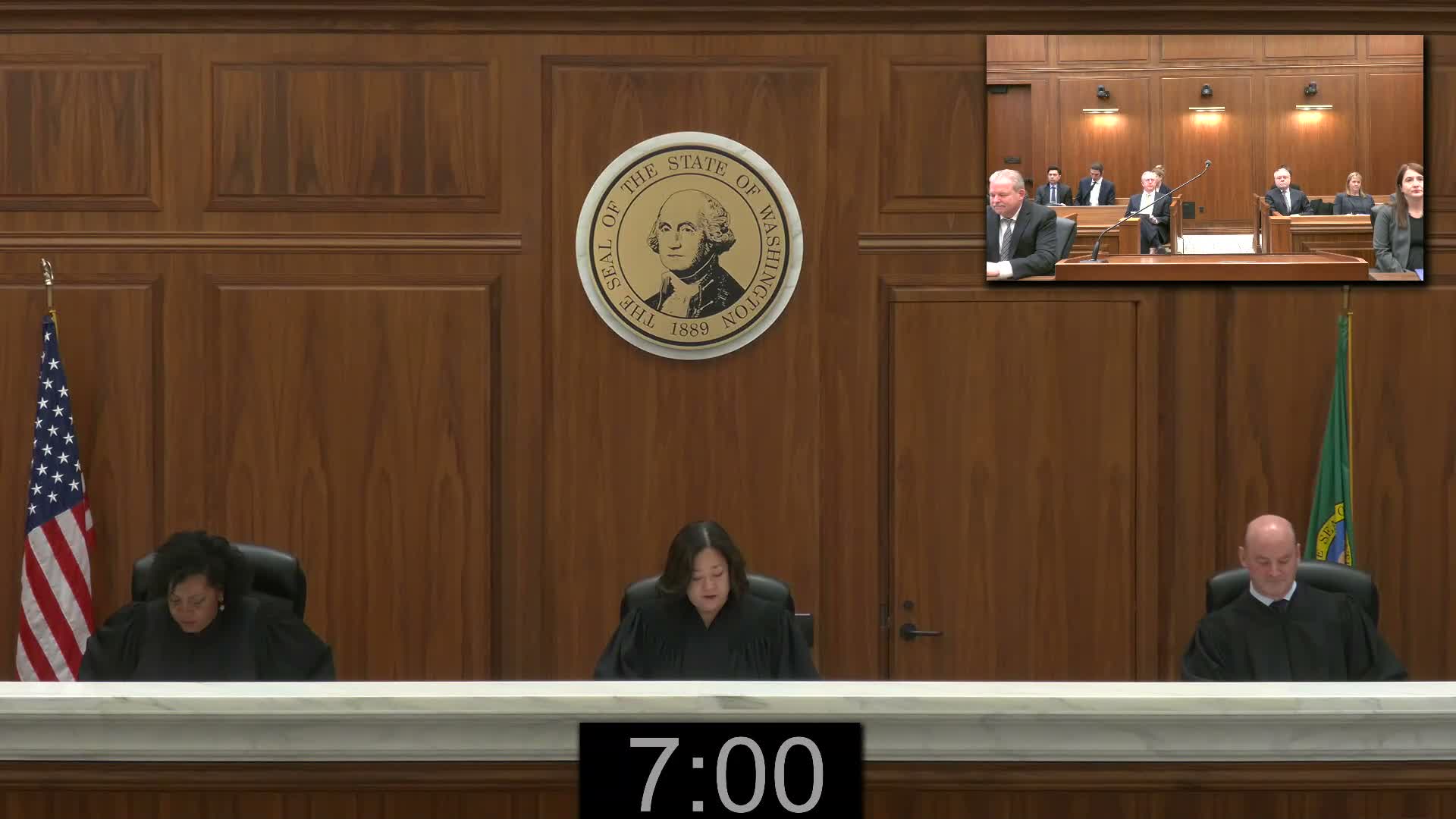
An appellate panel heard argument in the case announced in court as "Kate of Washington v. Shane Baker," focusing on whether a trial judge erred by giving a "first aggressor" jury instruction and on related sufficiency and misconduct claims. Defense counsel Sarah Tablada argued the instruction was improper and urged reversal; the prosecutor asked the court to affirm convictions and to vacate a duplicative second-degree murder count if the panel upholds first-degree felony murder.
"My name is Sarah Tablada and I represent mister Baker," defense counsel said at the start of argument, reserving two minutes for rebuttal and framing a two-prong challenge to the instruction. Tablada told the court that (1) the defendant's alleged acts — described in the record as car prowling and sleeping in a vehicle that did not belong to him — were not reasonably likely to provoke a belligerent response, and (2) as a matter of law a third party may not use force to recover property belonging to someone else, so the instruction was unavailable.
The prosecutor, Ed Stemler of the Snohomish County Prosecutor's Office, responded that the state need only produce "some evidence" that the defendant used force sufficient to provoke a belligerent response and that the jury should resolve factual disputes about who first used force. "I'm Ed Stemler from Snohomish County Prosecutor's Office," Stemler told the panel, asking the court to affirm the convictions and sentence with one exception: if the panel affirms first-degree felony murder, the second-degree murder conviction based on the same homicide should be vacated to avoid duplicative punishment.
Stemler described a sequence of events the state says the record supports: the defendant entered a vehicle belonging to another person, removed a backpack, that backpack was recovered by a third party (Giannini), and the defendant displayed a gun while the confrontation unfolded. The prosecutor pointed to corroborating physical evidence — including forensic traces on the recovered vehicle and a fingerprint on a gas station card — and cited precedent the state said supports inferring intent from pre-homicide acts.
Defense counsel and the bench focused on the chronology and the video evidence, debating whether the third party's actions (approaching the car, rousing the occupant, constraining movements) were the initial use of force and whether those acts made a belligerent response by the shooter reasonably likely. A bench exchange acknowledged the underlying homicide: a judge remarked, and counsel agreed, that the shooter killed Mr. Poland with a weapon; counsel stressed that factual background did not resolve the legal question about the instruction.
The defense also raised an issue it presented as prosecutorial misconduct arising from trial testimony and cross-examination about whether a witness (Castro) had seen the defendant on television. Counsel argued parts of the cross-examination and the court's contemporaneous remarks read on the record as confusing and possibly prejudicial; the state countered that the court's statements were rulings and not comments on the evidence and that corroborating video and forensic material reduced the need for any accomplice instruction for Castro.
Tablada urged the panel to read the trial transcript and to reverse, arguing the record shows insufficient basis for the instruction and that the court's exchanges during closing could be read as a comment on the evidence. Stemler responded that questions of who first used force and whether self-defense applies are factual matters for a jury and that the evidence the state cited supported submission of the instruction.
The panel did not announce a decision at the close of argument. The clerk called the next matter on the calendar (Young's Market) after oral argument concluded.