Get Full Government Meeting Transcripts, Videos, & Alerts Forever!
Get email alerts on the Choice Of Law topic
No spam. Unsubscribe anytime.
Washington Supreme Court hears dispute over statute of repose and punitive damages in PCB litigation
Summary
The Washington Supreme Court on oral argument considered whether the state's product-liability law (WPLA) and its 12-year statute of repose apply to claims tied to manufacturing conduct in other states, and whether punitive damages can be grafted onto a WPLA claim; counsel for both sides clashed over choice-of-law precedents and the statute's legislative record.
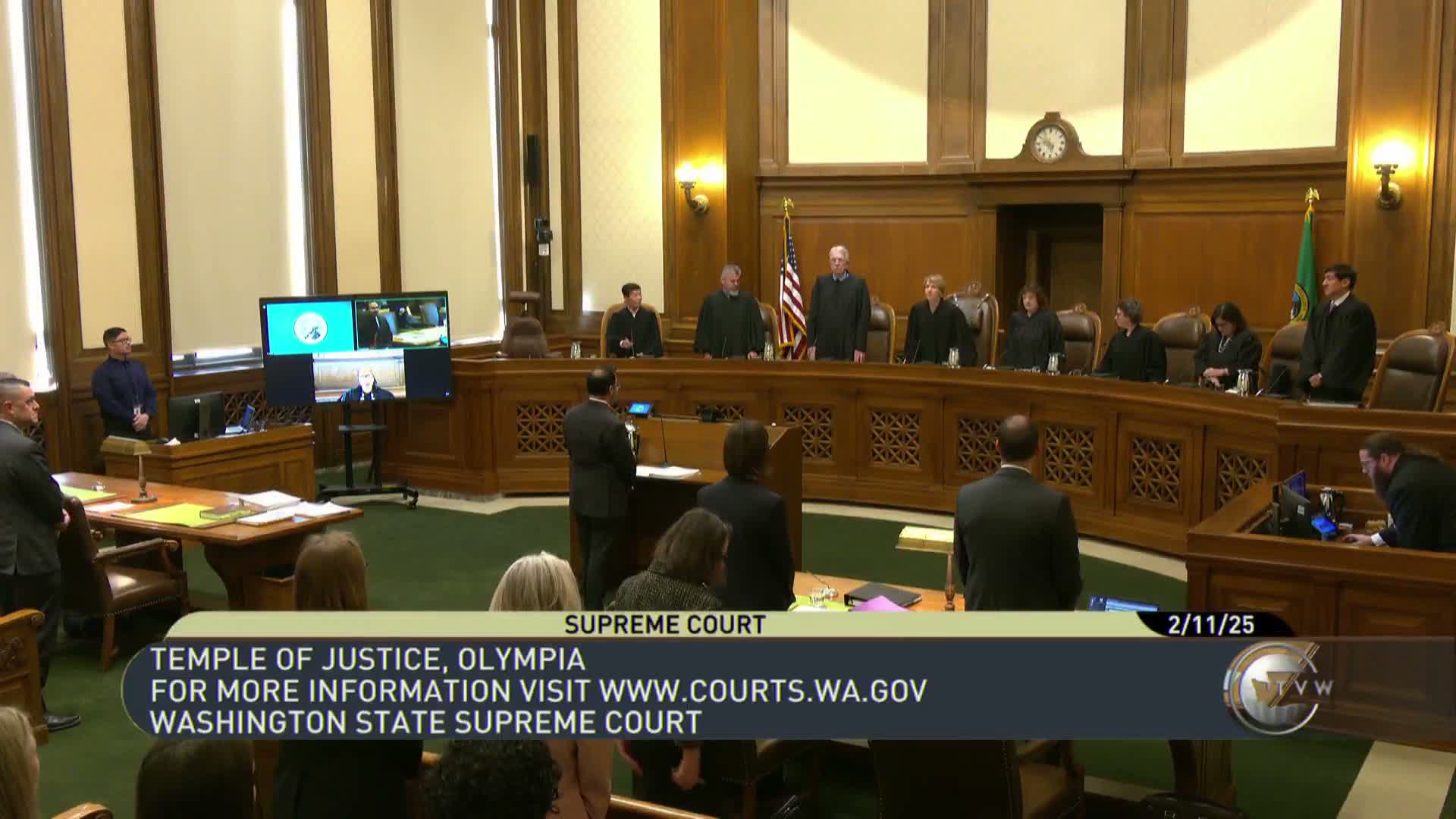
The Washington Supreme Court heard oral arguments in Carrie L. Erickson v. Pharmacia LLC, a case over whether Washington's statute of repose and the Washington Product Liability Act (WPLA) can bar or shape claims by schoolteachers and students exposed to PCBs allegedly manufactured and distributed years ago. Plaintiffs' counsel Deepak Gupta told the court that the core question is "whether Monsanto may invoke Washington's statute of repose to close the courthouse doors and immunize conduct that took place years ago in Missouri before the Washington statute was even enacted."
Gupta said the law of the place where the manufacturer's conduct occurred should govern repose and noted "for decades, from its Missouri headquarters, Monsanto orchestrated an elaborate scheme to conceal that its PCBs not only last forever, but are extremely toxic." He argued that Washington has little legitimate interest in shielding conduct that occurred outside its borders and that, under long-standing Washington choice-of-law precedent, conduct-focused rules like repose should be governed by the law of the state where that conduct occurred.
Responding for Pharmacia, Lauren Goldman of Gibson, Dunn & Crutcher told the justices the plaintiffs chose to bring their claims under the WPLA and that the legislature deliberately bundled a set of policies into that statute: a comparatively low bar for liability, generous compensatory damages, and—importantly—no punitive damages. Goldman warned against a result she called a "legal Frankenstein" that would mix Washington's liability rules with another state's punitive-damages regime, saying that approach "didn't reflect either state's policy."
A central dispute before the court was whether the WPLA's provisions travel together under issue-by-issue choice-of-law analysis or whether the statute preempts that inquiry for certain remedies. Counsel debated whether repose is properly treated as an affirmative defense (which the defendant must plead and prove) or an integral element of the claim that must "travel" with the WPLA. Justices pressed both parties on precedent, including Rice and related Washington decisions that applied issue-by-issue interest analysis, and on whether adopting a different restatement of choice-of-law rules would be appropriate.
The bench also examined the WPLA's legislative record and whether it meets the heightened-scrutiny standards set out in prior state decisions (Bennett and de Young) when a statute effectively limits or immunizes certain claims. Goldman pointed to a multi-page task force report and legislative findings that lawmakers relied on to justify a 12-year repose, saying the record shows a rational nexus between the legislature's findings about long-tail liability and its chosen statutory limits; Gupta countered that the record did not make the necessary connection and that the issue implicates constitutional scrutiny.
Justices asked detailed procedural questions as well, including whether trial courts would need to bifurcate proceedings, how jury instructions would treat post-sale failure-to-warn claims, and how to avoid forum-shopping if elements of different states' rules were applied. Counsel acknowledged those practical difficulties but disagreed on how choice-of-law rules should accommodate them.
After extended questioning by multiple members of the court on issues of precedent, statutory interpretation, and constitutional scrutiny, counsel made brief final points. The case was submitted and the court adjourned.
The argument focused on legal doctrine and procedure rather than factual disputes about exposure and injury; the court did not announce a decision at the hearing. The justices will decide whether Washington's repose provision and the WPLA's policy choices govern this litigation or whether certain defenses and remedies should be determined under the law of the states where the defendant's conduct occurred.