Get Full Government Meeting Transcripts, Videos, & Alerts Forever!
Get email alerts on the Action Plan Operations topic
No spam. Unsubscribe anytime.
City staff outline 2024 action-plan results, housing and energy priorities; council presses on transit reliability
Summary
Staff reported progress on Rochester's 2024 action and operations plan, highlighted housing initiatives and early steps toward renewable power goals for 2030; council questioned transit contractor performance (Zips on-time 92% vs 93% goal) and asked for more data on rental conversions and operations metrics.
City staff used the Feb. 24 study session to review the 2024 action-plan and operations dashboard that ties to council priorities (affordable living, quality services, economic vibrancy). Mr. Parrish highlighted housing investments (support for 134 units via the Coalition of Rochester Area Housing, conveyance of lots for single-family construction, and a planned 380-unit project on Civic Center North) and operational statistics including RPU updates and service metrics.
On energy, staff said the city is "marching toward" a post-2030 power-supply strategy and the renewable 2030 goal but warned that funding strategies and projected energy needs (data centers, EVs, AI workloads cited as potential demands) make that planning complex and potentially costly.
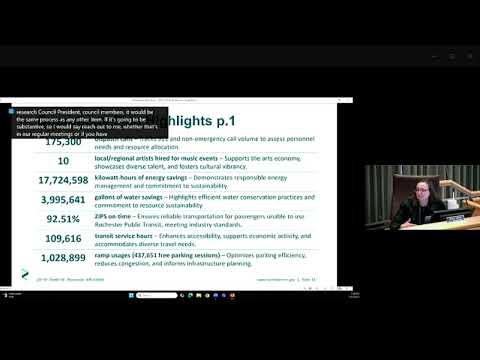
On operations, the city reported improved transit and parking metrics: Zips on-time performance was reported at 92% (with a stated goal of 93%); parking ramp utilizations were roughly 977,000 in 2023 with many short free uses; 3-1-1 adoption and website traffic were cited as measures of digital-service engagement. "We are marching toward this transition plan for post 2030 power supply needs and being renewable at that point," Parrish said during the presentation.
Council members pressed staff on how to improve Zips reliability: some members asked why the on-time goal is 93% and whether council could set a higher target. Staff said driver availability, contractor controls and contract design are constraints, and recommended improvements in communication to riders (encouraging 24-hour advance requests) and potential contractual teeth in future procurements.
On housing stock changes, staff said basic owner-occupied versus renter statistics can be tracked using census and state demographer data and that new rental-permit filings (and permit databases such as Exela) can be used to track loss of owner-occupied units or spikes in investor purchases; staff offered to provide reports on rental permits and trends on request.
Next steps and actions: staff will continue to deliver twice-yearly action-plan updates, provide requested cross-tab data and operational trend lines on parking and transit, and return budget and strategic planning proposals in the spring and summer as part of the fiscal-year process. The council's next study session is March 10.