Get Full Government Meeting Transcripts, Videos, & Alerts Forever!
Get email alerts on the Constructive Filing topic
No spam. Unsubscribe anytime.
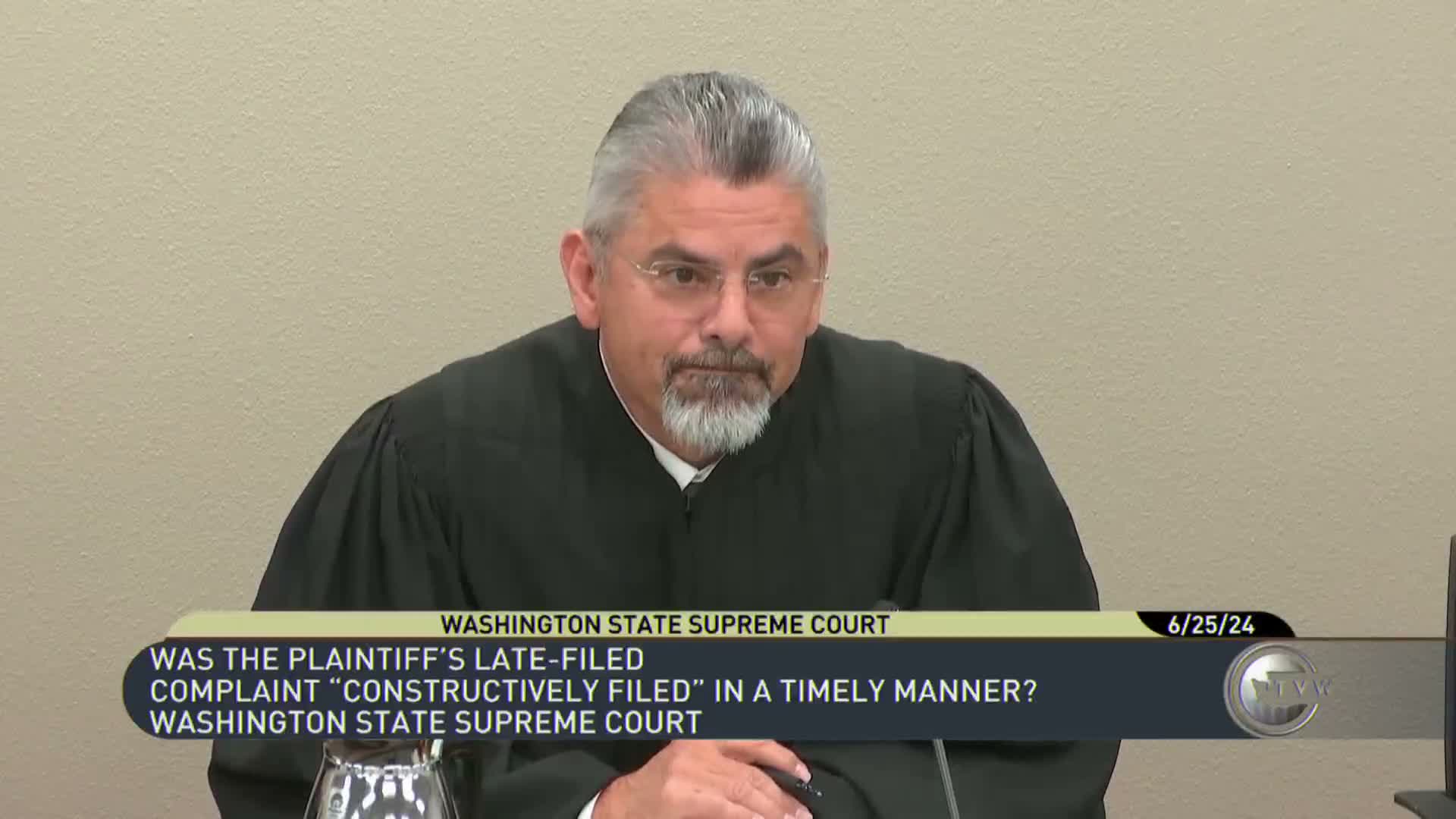
Washington Supreme Court hears arguments on ‘constructive filing’ in Wall v. Grover
Summary
In oral argument June 25, 2024, the Washington Supreme Court heard competing counsel over whether a complaint submitted by e‑filing should be treated as 'constructively filed' when the clerk's office records show the complaint was not received during business hours. Counsel disputed the objective record and whether the issue requires a factual hearing or a change in state law.
TUMWATER, Wash. — The Washington Supreme Court on June 25, 2024 heard argument over whether a lawsuit that a petitioner says was submitted by e‑filing within the statute of limitations should nevertheless be dismissed when the clerk’s records show the complaint was not received during court business hours.
David Williams, counsel for petitioner Michael Wall, told the court he watched his legal assistant upload the complaint, the summons and pay the filing fee and that the record therefore raises a genuine factual dispute that should prevent dismissal. “We filed the document at 01:58. We got a rejection at 02:56,” Williams said, describing the sequence of acknowledgments and the office’s later notice.
Amy Verbanzi, counsel for the respondent (Anderson Hunter Law Firm), countered that the objective documents in the record show only the summons was received in a timely way and that the complaint did not reach the clerk’s custody. “This case is not a case of constructive filing. This is a case of a late filing,” Verbanzi told the bench, directing the court to emails and system snapshots in the record submitted below.
The central legal question presented was whether Washington should adopt or apply a doctrine of "constructive filing" — a rule under which a filing that was sent or properly prepared within the statutory period may be treated as timely even if the clerk’s system did not accept or register the document before court hours ended. Williams asked the court to adopt that doctrine and to remand the case for trial; alternatively he urged reversal of the Court of Appeals on the ground that disputed facts (including whether the complaint was ever uploaded) should be resolved after discovery.
Respondent counsel argued the state’s practice and precedent require the documents necessary to commence an action to be received during court hours. Verbanzi cited the record, including a rejection email time-stamped about 02:56 p.m. and a later entry acknowledging receipt of the complaint at about 04:37 p.m., and urged the court to affirm the lower-court disposition.
Justices pressed counsel on procedural posture, burden at the summary‑judgment stage, and whether the issue is one of credibility (for a factfinder) or one of law appropriate for this court to resolve. Several justices asked whether technological glitches or varying county filing hours should ever excuse a late reception of a filing and whether Washington precedent (the panel discussed Margitin) and applicable court rules require receipt rather than mere sending.
Counsel agreed that if the court were to permit some form of constructive filing, it would likely be limited to extraordinary circumstances (for example, a courthouse closure or a systemic outage) rather than routine e‑filing errors. Verbanzi said the record here lacks independent evidence of a systemic outage or other extraordinary reason why the complaint did not reach the clerk, and she noted the possibility of an audit or testimony from the person who performed the upload if the case were remanded.
At the end of argument the petitioner presented a brief rebuttal reiterating that his declaration and the payment record create issues for summary judgment and that the court should either adopt constructive filing or remand for factual development. The court took the case under submission and recessed; no decision was announced from the bench.
The court and counsel referenced state rules and authorities during argument, including RCW 4.16.080 and the court rule GR 30, as well as cited decisions addressing constructive‑filing analogues in other jurisdictions. If the court issues an opinion, it will clarify whether Washington will treat certain late or rejected e‑filings as constructively filed or will require receipt within the clerk’s business hours as the controlling test.