Get AI Briefings, Transcripts & Alerts on Local & National Government Meetings — Forever.
Washington Supreme Court hears dispute over whether courts can reduce restitution tied to state victim-compensation payments
Loading...
Summary
At oral argument in State v. Montreal Lee Anthony Morgan Sr., defense counsel urged that sentencing courts retain discretion to set restitution amounts under the Sentencing Reform Act; the state argued the restitution statute and the Crime Victims Compensation Act require courts to order the amount the fund paid. The court took the case under advisement and recessed for 10 days.
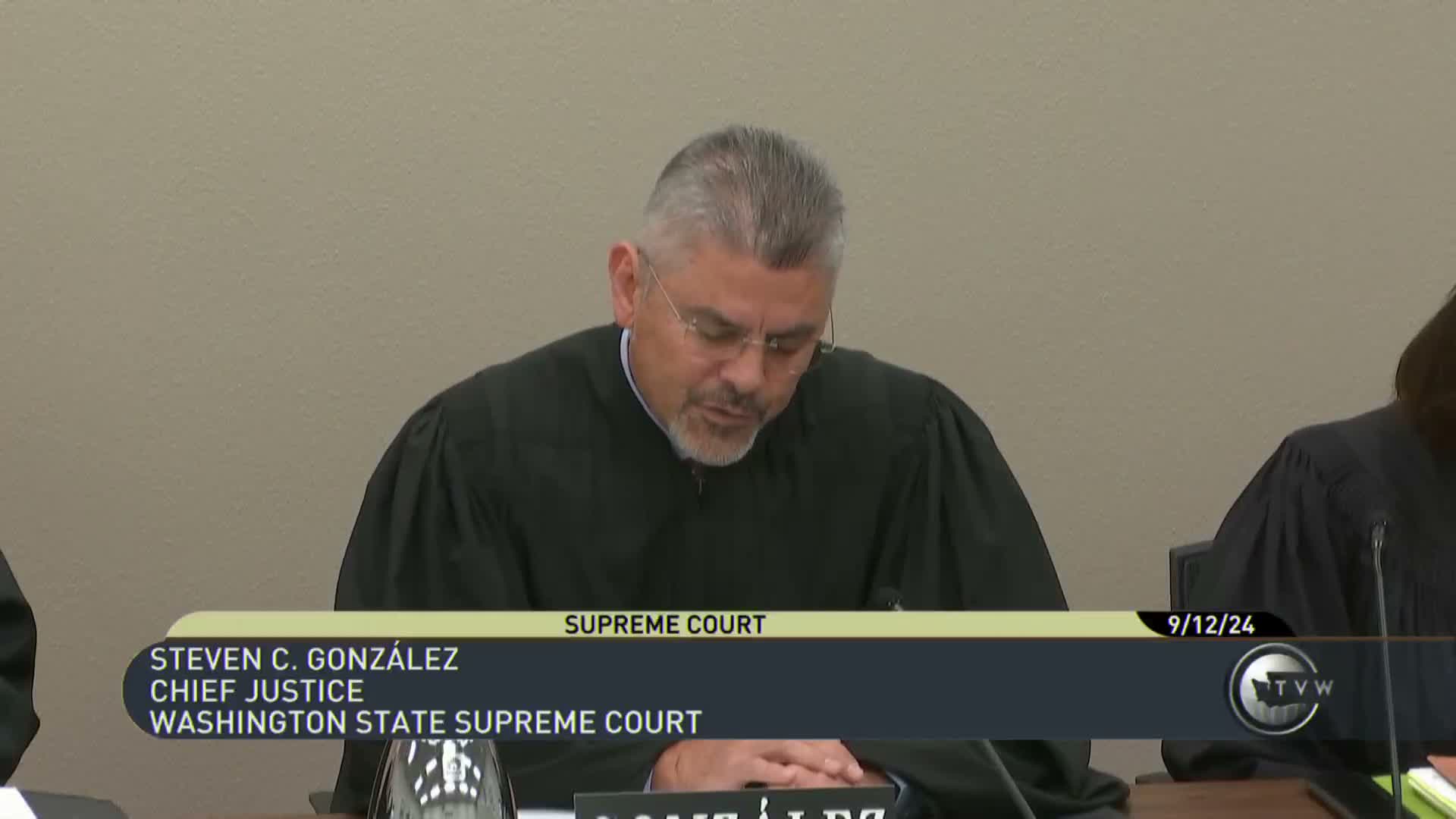
The Washington Supreme Court heard argument on Sept. 12, 2024, over whether a sentencing court may reduce a restitution order below the amount the Crime Victims Compensation Fund (administered by the Department of Labor and Industries) seeks to recover. Defense counsel, identified on the docket as Kate Benward, told the court that restitution serves punitive, compensatory and rehabilitative goals and that RCW 9.948.7537 allows the sentencing court to determine the appropriate restitution amount for a particular defendant.
The dispute centers on the interplay between the restitution statute and the Crime Victims Compensation Act. "The statute requires the court shall order restitution," defense counsel said in argument, urging the court to read the statute to permit a sentencing court to exercise judgment consistent with the Sentencing Reform Act. Counsel argued that treating the agency's calculation as controlling would add words to the statute and create absurd constitutional consequences.
State counsel Amy Meckling countered that the plain language of the restitution statute, read with the Crime Victims Compensation Act, requires a sentencing court to enter a restitution order equal to the benefits the program paid to an entitled victim. "Subsection 7 ... specifically says, shall anytime a victim is entitled to benefits under the act, the court shall enter a restitution order, period," Meckling told the justices, noting that the CVCA treats payments as a debt "due and owing" to the department and that the legislature has limited the court's ability to waive or reduce that debt for Labor and Industries in a recent amendment.
Justices pressed both sides on several related questions: whether the Department of Labor and Industries (DLI) must or may petition for restitution and, if it petitions, whether the figure it requests is necessarily the amount the court must order; whether the trial court may independently assess causation when the agency has already found proximate cause; and how plea agreements that reserve restitution to be "determined" interact with these statutory obligations. Defense counsel said sentencing courts routinely consider culpability, plea facts and rehabilitative goals and that a court could impose a nominal restitution amount where appropriate. The state said courts may rely on the agency's factfinding but still must ensure substantial credible evidence supports the amount sought.
The argument also touched on practical questions including joint-and-several liability among co-defendants, the timing of petitions (the statute includes a one-year petition deadline), and the effect of the agency's later decision to waive or modify the debt (the department can satisfy a judgment by sending a satisfaction notice if it later waives or reduces the debt). The record in the case includes a plea in which the defendant agreed to restitution "to be determined;" Meckling said the amount at issue included about $10,000 in medical and burial expenses paid by the fund.
Both sides asked the court to rule in their favor: the state to hold that subsection 7 requires a restitution order matching the fund's payment, and the defense to hold that a sentencing court retains discretionary authority under the Sentencing Reform Act to determine an appropriate amount. The court thanked counsel, submitted the case and recessed for 10 days.
The Supreme Court will issue a written decision after deliberation. The record in the argument relied chiefly on RCW provisions the parties cited and on the court's existing precedents on restitution and agency findings.