
Planning commission recommends updated communication-tower ordinance with larger setbacks and added monitoring
Get AI-powered insights, summaries, and transcripts
Subscribe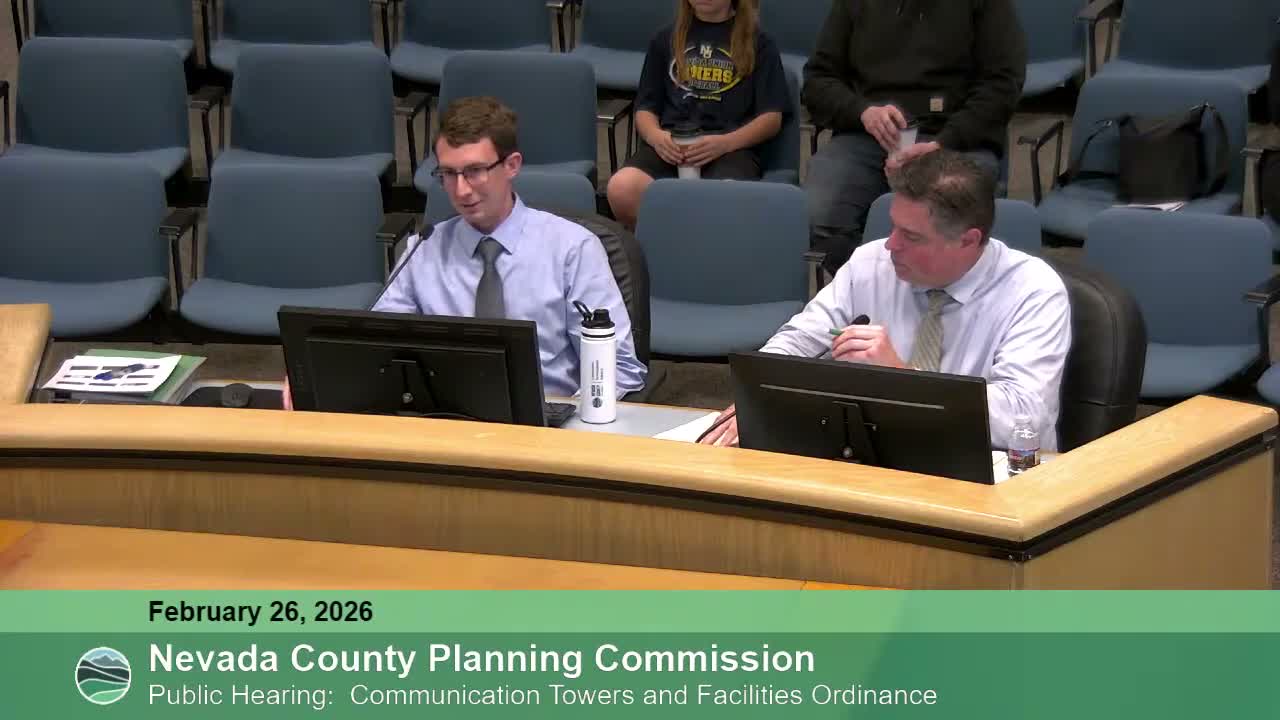
Summary
The Nevada County Planning Commission voted Feb. 26 to recommend the Board of Supervisors adopt amendments to the county Communication Towers and Facilities Ordinance that increase neighborhood notice and setbacks, require post‑installation RF verification, and remove replacement-of-equipment from an exemption list; commissioners also directed further work on monitoring, decommissioning and accountability.
The Nevada County Planning Commission on Feb. 26 voted unanimously to recommend that the Board of Supervisors adopt revisions to the county Communication Towers and Facilities Ordinance intended to modernize rules for cell sites and related equipment.
Planning staff presented the draft as a balance between broadband expansion and neighborhood protection. "This presentation before you today is about Proposed Amendments to the Nevada County Communication Towers and Facilities Ordinance," David Nicholas, associate planner, told the commission, outlining changes that include updated definitions, exemptions for certain small wireless facilities, greater public notice and requirements for post‑installation radio‑frequency (RF) verification.
Why it matters: the county’s ordinance had not been substantially updated in two decades, and commissioners and residents said new rules are needed because of advances in wireless technology, concerns about neighborhood compatibility, and wildfire risk. Staff proposed raising the concealment standard and increasing public notice from a typical 300–500 feet to a 1,000‑foot pre‑application and hearing notification radius, and recommended a new setback standard equal to 150% of a tower’s height to reduce visual impacts.
Public comment was extensive and mixed. Residents and advocacy groups urged stronger protections: Johanna Finney of Nevada County For SafeTech said the group’s model ordinance would require larger setbacks, decommissioning bonds and independent review. "This template we offer is not a burden, it's a road map," she said. Several speakers described health worries or reported personal symptoms they associated with nearby towers; others, including a nearby property owner, complained about noise and generator impacts.
Industry and tower owners cautioned against rules that could block coverage. "We urge you guys to, just keep the 100 foot setback," Jeremy Stroup of Verizon said, arguing that the staff’s parcel analysis—showing roughly 12% of county parcels could host towers under some setback scenarios—indicated a 150% setback could severely limit feasible sites.
Key technical changes and clarifications - Small wireless facilities remain treated as limited‑impact when matching federal size thresholds (antennas less than roughly 3 cubic feet; small cell equipment limits described in the staff report). - Staff proposed a post‑installation RF compliance step requiring a field verification letter within 60 days confirming measured emissions align with modeled projections; similar reports would be required after significant modifications. - Notification would be expanded to include a pre‑application notice to neighbors within 1,000 feet and an increased public hearing notice radius. - The draft clarifies that some incremental administrative actions (eligible facilities requests) remain subject to federal definitions and shot‑clock rules; the federal shot clock begins when an application’s first procedural step is submitted and is tolled if the county issues an incomplete determination.
Commission direction and vote Commissioners spent significant time probing CEQA, RF monitoring, defense of life‑safety planning and whether pending applications should be grandfathered. Staff said the ordinance text as proposed relies on case‑by‑case CEQA review for individual permits while the ordinance update itself is recommended to be found exempt under CEQA general‑rule exemptions. Staff also said fire planners and local fire districts review tower applications and defensible‑space requirements are part of the site plan review.
The commission added language clarifying that complete applications filed before the ordinance’s effective date would remain under the prior code, but incomplete applications could be subject to the new standards. The body also voted to remove the replacement‑of‑existing‑equipment exemption from the list of automatically exempt projects so those work items would be reviewed as administrative development permits (ADPs). Commissioners directed staff and the Board to further explore monitoring, decommissioning bonds or financial assurances, and public access to compliance records.
Outcome and next steps The motion to recommend adoption as amended passed unanimously. The Planning Commission will forward the recommendation to the Board of Supervisors; staff stated the ordinance would become effective 30 days after Board adoption and commissioners discussed asking the Board to adopt the clarified grandfathering language. Staff also agreed to continue outreach and technical discussions with community groups about monitoring and accountability.
What’s next: the Board of Supervisors will consider the ordinance; the commission recommended additional work on monitoring and decommissioning language before final adoption at the county level.