Get Full Government Meeting Transcripts, Videos, & Alerts Forever!
Get email alerts on the Consumer Protection topic
No spam. Unsubscribe anytime.
Washington Supreme Court hears dispute over Walgreens’ “non drowsy” label
Summary
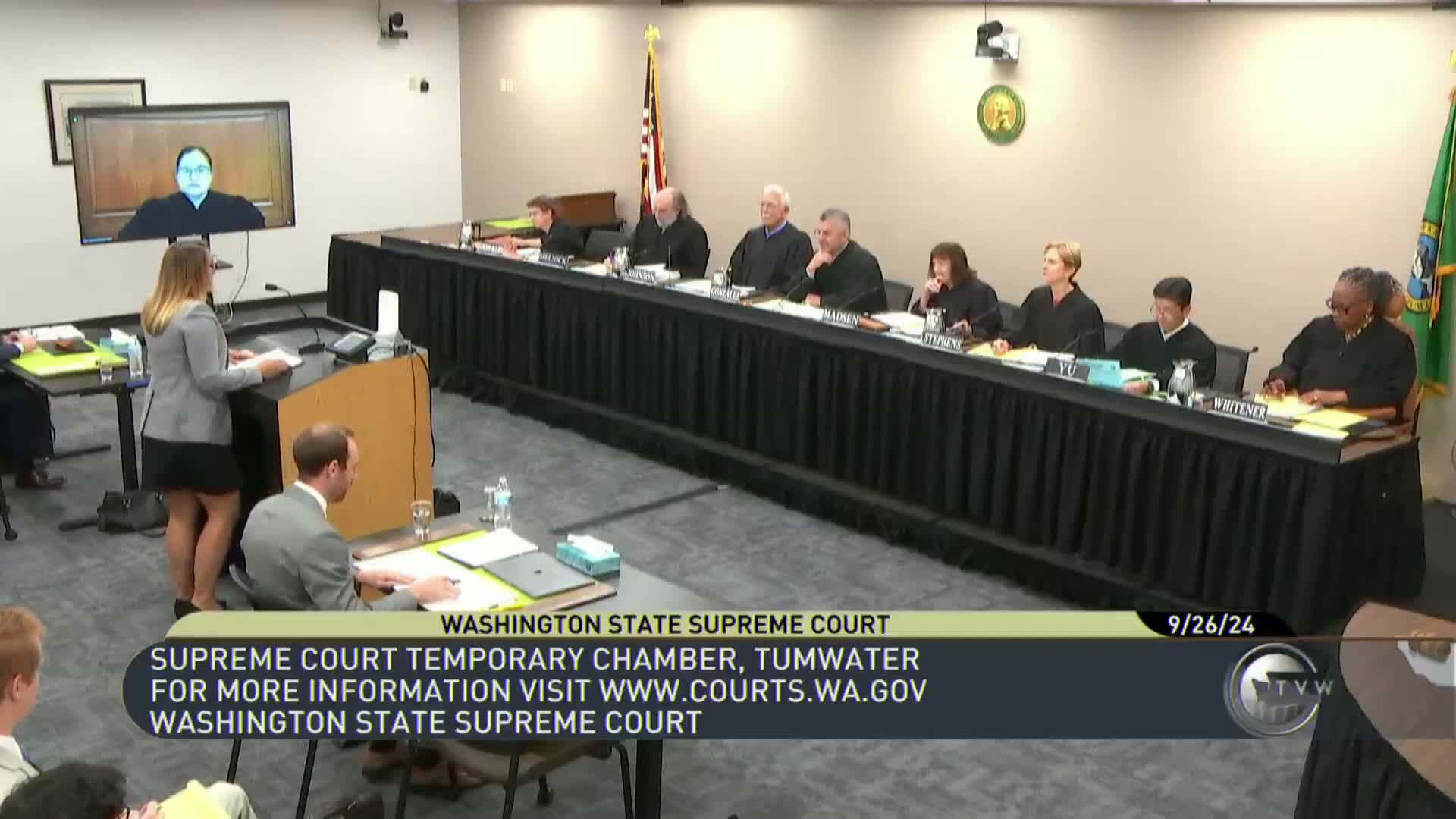
The Washington Supreme Court on Sept. 26, 2024, heard arguments in Tracy Hall v. Walgreens over whether Walgreens’ prominent “non drowsy” label on a DXM-containing cough medicine is protected by the Consumer Protection Act’s safe-harbor exemption because the FDA has regulated drowsiness labeling. Counsel disagreed about whether the FDA’s monograph constitutes specific permission for an affirmative label claim.
The Washington Supreme Court heard oral argument on Sept. 26, 2024, in Tracy Hall v. Walgreens Boots Alliance Inc., a case about whether Walgreens’ prominent “non drowsy” label on an over‑the‑counter cough medicine is shielded from the state Consumer Protection Act by a statutory safe harbor for conduct "permitted, prohibited, or regulated" by federal regulators.
Emily Weisenberger, counsel for Walgreens Boots Alliance Inc., told the court the FDA has already addressed drowsiness labeling for antitussive drugs and that the agency’s monograph places dextromethorphan (DXM) products in a category that does not require a drowsiness warning. “The FDA specifically regulated the labeling on drowsiness,” Weisenberger said in opening, arguing that the existence of that federal regulation informs whether the state safe harbor applies.
Several justices pressed counsel on the precise question before the court — whether the certified question requires the court to decide only whether the conduct was "permitted" or whether the broader verbs in the statute ("permitted, prohibited, or regulated") are implicated. Weisenberger said the district court certified the state‑law question for this court to resolve and reiterated that the statutory exemption should reach the conduct at issue because the FDA considered drowsiness when it developed the monograph.
Gabriel Doble, counsel for plaintiff Tracy Hall, said Walgreens cannot meet the CPA’s "specific permission" test. “This case is about Walgreens placing an affirmative and prominent non drowsy label on its cough medicines despite the fact that those medicines can and do cause drowsiness,” Doble told the court. He argued the FDA monograph did not specifically permit or address affirmative “non drowsy” statements and that the Legislature’s 1974 amendment to the CPA showed an intent to limit the exemption for agencies outside the three statutorily listed bodies.
Doble pressed the court that, for agencies not listed by name in the statute, the exemption applies only to conduct expressly permitted by that agency. He pointed the justices to statutory history and decisions interpreting the safe harbor, and cited federal court decisions the plaintiff says show the monograph is silent regarding affirmative non‑drowsy claims.
Justices asked detailed questions about the relationship between federal preemption doctrine and the narrower state safe harbor, whether an FDA decision not to require a warning is equivalent to an affirmative permission to make a countervailing marketing claim, and how the court should treat the monograph’s categorization of sleep‑aid or drowsiness claims. Counsel on both sides cited prior cases (including Miller v. U.S. Bank and Estes v. Wells Fargo) in discussing how courts have applied the exemption in different regulatory contexts.
After rebuttal from Walgreens’ counsel arguing the exemption should be read to avoid unduly restraining reasonable commercial practices, the court recessed and took the case under submission.
The court submitted the certified question; no opinion was announced from the bench. The court recessed for 10 minutes and the case was noted as submitted to the justices for decision.