Get Full Government Meeting Transcripts, Videos, & Alerts Forever!
Get email alerts on the Municipal Code Updates topic
No spam. Unsubscribe anytime.
Pflugerville council adopts local building‑standards board, tightens nuisance and vehicle rules and adjusts TCO fees
Summary
Council voted on multiple code updates on first reading Feb. 10, creating a quasi‑judicial Building and Standards Commission, revising junked‑vehicle and public‑nuisance rules to align with state law, and giving the city manager limited discretion to cap some temporary certificate of occupancy renewal fees.
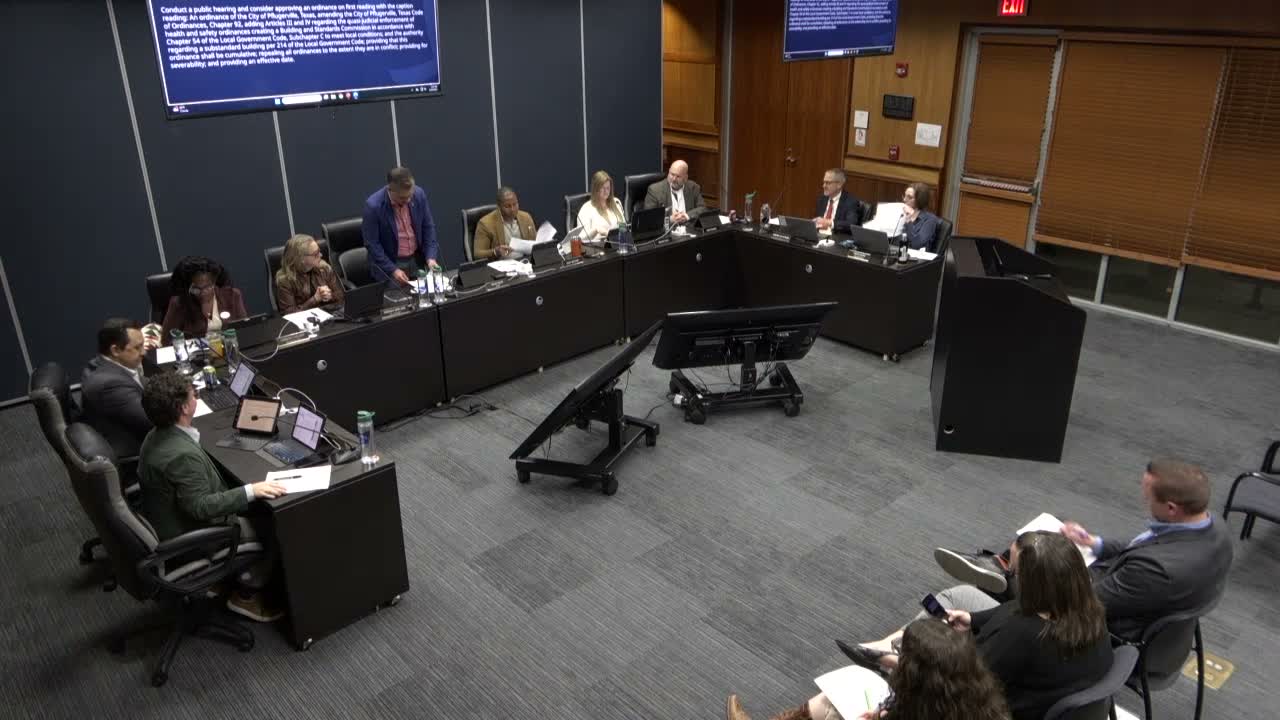
Pflugerville’s City Council on Feb. 10 approved a package of code changes on first reading that creates a local Building and Standards Commission and clarifies nuisance, junked‑vehicle and construction code procedures.
City Building Official Robert Polanco told the council the new Building and Standards Commission would provide a local, quasi‑judicial venue to hear evidence, issue orders and avoid many cases going directly to district court. “The Building and Standards Commission will provide a structured, impartial venue to hear evidence, make findings of fact, and issue orders related to substandard buildings,” Polanco said, explaining the change grew out of a multi‑year, unresolved burned‑house case.
Council members spent substantial time questioning quorum and removal‑for‑cause language, the commission’s authority over private property, and how the commission’s procedures compare with other quasi‑judicial boards. After debate, the council approved the ordinance creating the commission on first reading by a 6–1 vote.
Polanco also presented a rewrite of the city’s junked‑vehicle code to align definitions and timelines with state law. The draft clarifies that junked vehicles on private property can be administratively abated without resale, that VINs will be removed from DMV records once a vehicle is classified as junk, and that notice procedures are updated to require certified mail and posting when personal service is not possible. A resident who represents a homeowners association asked why state timelines (48 vs. 72 hours and extended identification windows) were adopted; Polanco said he would provide the specific statute citations after the meeting. The council adopted the junked‑vehicle ordinance on first reading unanimously.
Separately the council approved a comprehensive rewrite of the public‑nuisance and health and sanitation chapter to replace subjective language (for example, “substantially annoys”) with objective standards, separate high‑weeds rules into a dedicated article, and standardize notification and enforcement. Council discussion focused on the fines section, which references a range of $10 to $2,000 per offense per day; council members asked that the ordinance clarify that fines are administered via municipal court and that appeal language be explicit in both the ordinance and the notice letters. Staff said notices include appeal rights and that municipal court handles enforcement.
The final ordinance in the package amends code cross‑references for construction and code appeals to direct building‑code appeals to the appropriate construction board of appeals rather than the planning board, and aligns the city’s code with several 2021 International Code editions.
Council also approved an amendment to the master fee schedule giving the city manager limited discretion to cap temporary certificate‑of‑occupancy renewal fees for projects making demonstrable, substantial progress; the ordinance sets a not‑less‑than $500 floor when manager discretion is applied. Planning and Development Director Ashley Bailey said the intent is to avoid punitive fee doubling for small businesses or projects that are substantially complete but delayed by circumstances such as supply‑chain issues.
All ordinances were approved on first reading; several items will return for a second reading and final adoption. Polanco said the new processes aim to provide clearer, more defensible enforcement tools while preserving due process and appeal rights through municipal and district courts.