Get Full Government Meeting Transcripts, Videos, & Alerts Forever!
Get email alerts on the Zoning Code Rewrite topic
No spam. Unsubscribe anytime.
Clarkdale advisory committee continues zoning-code rewrite, tables two items for later review
Summary
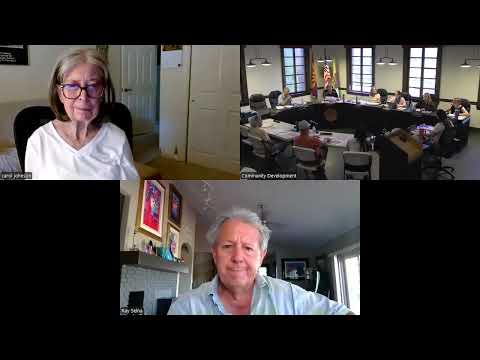
At a Sept. 11 special meeting, the Clarkdale Zoning Code Update Citizen Advisory Committee reviewed Chapters 1 and 4 and debated conversion tables, ADU/accessory-structure setbacks, campgrounds, parking and golf-course language; motions to table minutes and agenda item 5b were approved and Chapter 3 review was scheduled for the next meeting.
The Clarkdale Zoning Code Update Citizen Advisory Committee met Sept. 11 to continue work on a comprehensive rewrite of the town's zoning code, focusing on simplifying district categories and resolving technical standards. Chair called the meeting to order and, after roll call, the committee reviewed Chapter 1 (legal basis) and Chapter 4 (general provisions), and discussed proposed changes to Chapters 7 (signage), 8 (outdoor lighting) and 9 (landscape standards).
Staff and the code consultant described a proposed conversion table that consolidates closely related districts (for example combining R‑1L and R‑S3 standards into a single district). The consultant said this is primarily a text consolidation and does not, by itself, rezone properties on maps: "So nobody's gonna be not in compliance. They'll just have the least restrictive zone in there," the Staff member explained, adding that the town could perform a text amendment to the general plan and coordinate layers with Yavapai County GIS so mapping remains consistent.
Committee members pressed how the rewrite would be implemented in practice and whether the conversion would create parallel codes during the transition. One member said they feared creating "two parallel universes" of old and new rules and asked whether an opt‑in rezone or a short-term town-initiated conversion period could speed implementation; staff noted some jurisdictions offer a one‑year opt‑in window so property owners can be rezoned without fee during the update.
The meeting covered many topics beyond the conversion table: accessory structures and accessory dwelling units (ADUs) drew sustained discussion over setbacks, height limits and statutory constraints; campgrounds and RV parks prompted a call for a 20‑foot landscape buffer plus wall adjacent to residential uses; parking standards were expanded with exemptions for historic-district situations where on‑street public parking counts toward residential requirements; and golf-course rules were revised to make golf courses a planned-area development (PAD) so effluent use and water issues can be negotiated on a project-by-project basis.
On procedural matters, the committee approved a motion to table approval of the minutes until the next meeting and later approved a motion to table agenda item 5b and not transmit any items to the planning commission from that meeting. Chair closed by scheduling further review of Chapter 3 for the next meeting and adjourning the session.
The committee instructed staff to add statutory citations where state law controls (for instance ADU-related provisions) and to provide a redline of Chapter 3 at the next meeting so members can focus on technical standards.