
State Stepping Up adviser outlines jail-mental-health data framework to Riley County
Get AI-powered insights, summaries, and transcripts
Subscribe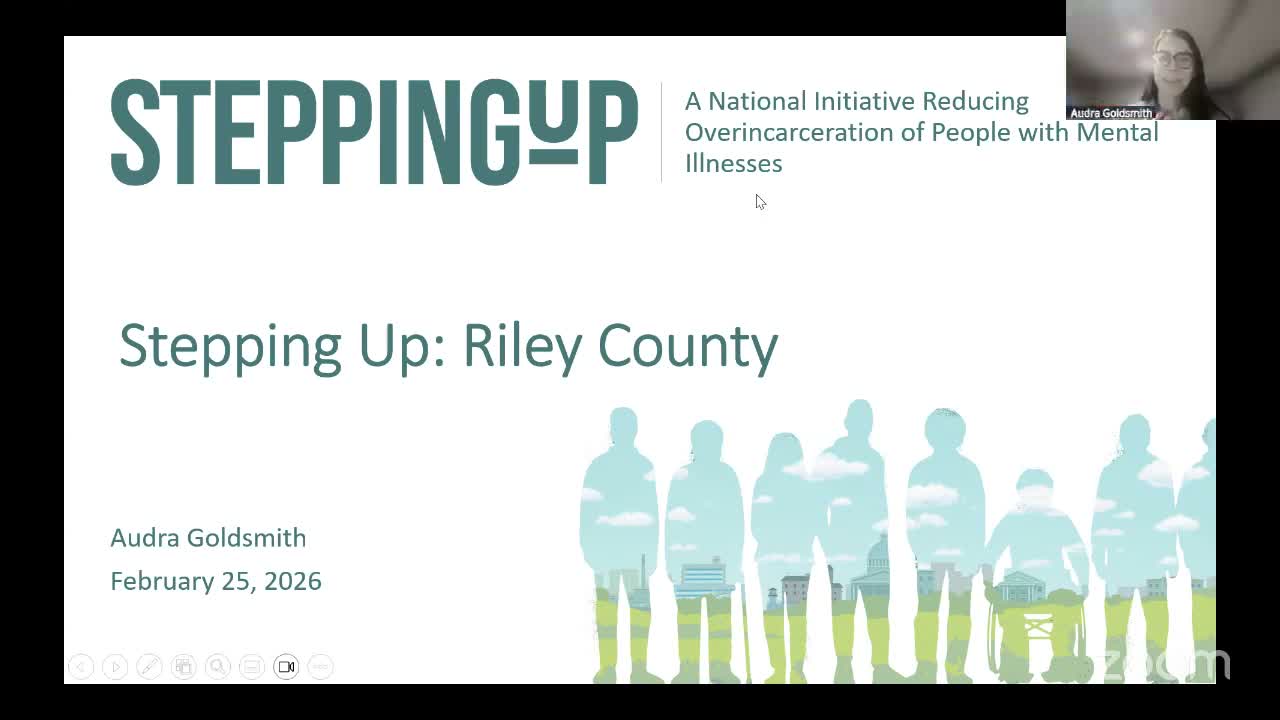
Summary
A Council of State Governments project manager urged Riley County to reenergize its Stepping Up effort, collect four core jail-mental-health measures and consider validated booking screening to guide services and divert people with behavioral-health needs from jail where appropriate.
RILEY COUNTY — Audra Goldsmith, project manager with the Council of State Governments Justice Center, told Riley County commissioners on March 2 that the Stepping Up initiative offers a data-driven framework counties can use to reduce incarceration and recidivism among people who have behavioral-health needs.
Goldsmith, who oversees the Kansas Stepping Up Technical Assistance Center, described six framework questions and four core measures she recommends Riley County collect: the number of people booked who identify mental-health needs, average length of stay for that population, connections to care after release and rates of return to jail. She also recommended using a validated brief jail mental-health screening at booking to identify needs and begin connecting people to treatment and community services.
"Stepping up is not a program. You don't have to buy into it," Goldsmith said. "It really is a framework…to talk about solutions and how to implement them in your community." She offered technical assistance, peer connections and templates for counties that want help implementing screening, data collection and coordinated policies.
Major Mark French of the Riley County Police Department joined Goldsmith in discussing jail data; French said the jail had been redesigned recently to consolidate pods and that the department is beginning to collect more operational information. Goldsmith said accurate, shared definitions across agencies are essential so the data can be compared and used for strategic planning.
Commissioners and panelists discussed where the Stepping Up work should live locally — as part of an existing mental-health task force or a subcommittee — and Goldsmith offered to help connect Riley County to other counties with mature data and programs.
Goldsmith said Stepping Up work often leads counties to consider models such as co-responder teams, CIT-trained officers and policies that strengthen connections to community care — all data-informed choices that depend on local services and capacity.
The commission did not take a vote on any new Stepping Up action at the meeting; Goldsmith said she would email resources and a template resolution to staff.