Get Full Government Meeting Transcripts, Videos, & Alerts Forever!
Get email alerts on the Rural Health Resources topic
No spam. Unsubscribe anytime.
NLM Region 7 demonstrates federal data tools to help rural health planning
Summary
Sarah Levinletter of the Network of the National Library of Medicine (Region 7) led a Nov. 20 training demonstrating USDA ERS datasets, the Rural Health Information Hub and MedlinePlus to help rural communities locate demographic, health and program-eligibility data for planning and grant applications.
Sarah Levinletter, outreach and education coordinator for the Network of the National Library of Medicine (Region 7), led a Nov. 20 webinar demonstrating federal data tools aimed at helping rural communities identify health needs and program eligibility.
Levinletter front‑loaded the session with two definitions of rural — the Office of Management and Budget county-level approach and the Census Bureau block-group approach — and stressed that which definition a program uses can determine grant eligibility. "So depending on the definition, around 15 to 20% of people in the United States live in rural areas," she said, using the range to frame how datasets count rural residents differently.
The presentation concentrated on three practical resources. Levinletter walked attendees through the U.S. Department of Agriculture Economic Research Service (ERS) — including the 'Rural America at a Glance' reports and a public Tableau of visualizations — the Rural Health Information Hub (RIHUB) state guides and mapping tools, and MedlinePlus for plain‑language health information (available in Spanish).
Using ERS, Levinletter demonstrated county‑level fact sheets, a mapped Atlas of Rural and Small Town America, and filters such as "MDs per 10,000 people" to compare nonmetro areas. She showed how ERS tables can be resorted to display states with low counts of physicians; as an example from the demo, she noted Oklahoma averaged roughly 6 MDs per 10,000 in nonmetro areas while Missouri and Texas averaged about 7 per 10,000.
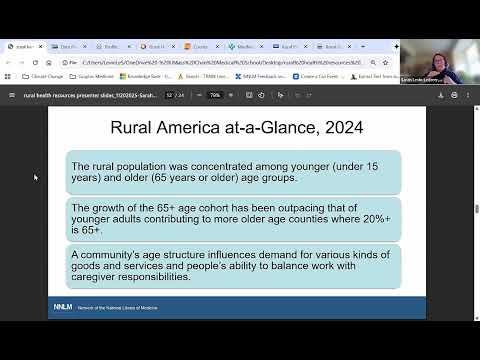
On demographic trends, Levinletter cited ERS and University of New Hampshire Carsey School findings that rural populations are aging and that child populations in many rural areas have grown more racially and ethnically diverse. She said the OMB definition counts about 46 million people (roughly 15% of the U.S. population) as rural, while the Census definition counts about 66 million (about 20%).
Addressing access to care, Levinletter said 136 rural hospitals closed in 2022 and described the Centers for Medicare & Medicaid Services' Rural Emergency Hospital (REH) conversion, a model available since January 2023. Quoting an October 2024 study, she said 32 hospitals in 14 states had converted to the REH model and that the conversions contributed to fewer rural hospital closures nationally in 2024 compared with the pre‑pandemic average.
Demonstrating RIHUB, Levinletter ran a state guide for Wilton in Franklin County, Maine, showing how the tool reports a location's Census/OMB classifications, mapped facility types, social determinants (broadband gaps, premature death trends) and program eligibility flags (for example: CMS rural designation: yes; primary care: yes; dental: yes; mental health services: no; Medically Underserved Area/Population: not met).
A participant in the chat asked where ERS's public Tableau is located; Levinletter directed them to ERS's home page under "data visualization" and noted that ERS charts are Creative Commons so long as the source credit is preserved.
Levinletter also ran the County Health Rankings demo to show county snapshots, premature death trends, leading causes and comparative tables that can be built within a state. She cautioned users about margins of error for small‑area estimates and encouraged checking the definition and scope of each dataset before using it for grant applications or program planning.
Closing the session, Levinletter highlighted MedlinePlus's plain‑language pages and Spanish translations as resources for patient and caregiver outreach and encouraged attendees to explore nnlm.gov for additional NNLM programs and handouts. The session recording notes that it was produced by the Network of the National Library of Medicine.