Lifetime Citizen Portal Access — AI Briefings, Alerts & Unlimited Follows
DARPA challenge highlights human-machine teaming in mass-casualty simulation
Loading...
Summary
At a DARPA triage challenge at the Guardian Center in Perry, Ga., medics and autonomous systems teamed in live mass-casualty runs; organizers said more than 750 simulated casualties were fielded and that aerial and ground robots fed medics real-time data during runs.
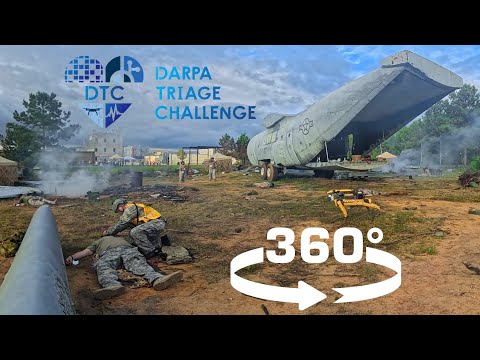
The Defense Advanced Research Projects Agency (DARPA) showcased a live demonstration of human-machine teaming March 2026 at the Guardian Center in Perry, Georgia, where medics worked alongside autonomous systems in mass-casualty simulations. Organizers said teams launched unmanned aerial vehicles (UAVs) and ground vehicles (UGVs) ahead of medics to locate and assess wounded participants and feed data to handheld devices used by responding medics.
DARPA's presenter described the event as an immersive, scientifically rigorous challenge designed to test how quickly and accurately systems can identify, assess and prioritize the wounded "as fast or faster than the medics do." The presenter said the command center monitored runs on multiple displays, including a Titan scoring dashboard and a Grafana visualization of ground-truth physiology and sensor status.
Organizers said challenge event number 2 fielded more than 750 casualties across an eight-day competition and used roughly 400 moulage units, equivalent to about 50 gallons of simulated blood, to enhance realism. Casualties were prepared with documented injury scripts, physiologic sensors and vital-sign transmitters so telemetry could provide continuous ground-truth data during each run.
The presenter named participating partners that supported operations and test integrity, including CETA teams, the Naval Information Warfare Center Atlantic and Johns Hopkins Applied Physics Laboratory. A team identified in the narration as "team Dart" was described as a top scorer; another team, "Team AirTags," was shown preparing UAVs and UGVs before a night-ambush run.
In one highlighted moment, the presenter described a robot alerting a medic directly on scene. "That collaboration between human and machine represents a glimpse into the future of life-saving care, faster, safer, and more coordinated than ever before," the presenter said. During the simulation a participant identifying themself as a Medic spoke from the field with short status calls such as "Go to the next patient" and "I'm a medic. I'm here for you." These role-play exchanges were used to simulate the cadence and pressure of real medics in the field.
Event organizers said some teams processed sensor data on servers while others relied on edge computing; most teams navigated manually, with a few attempting full autonomy. Before runs, casualties were geotagged, their wounds photographed and monitors verified through the Titan server, steps organizers said ensured repeatability and nearly indisputable ground-truth telemetry for scoring and analysis.
DARPA closed the event by announcing final scores for the challenge. Organizers framed the triage challenge as a forum that brings together robotics, data science and medicine to explore technologies that could change how medics operate in combat and disaster zones.
The demonstration did not announce any formal procurements or immediate policy actions; organizers emphasized the exercise's role in scientific testing and evaluation and the potential for future research and development steps.