Lifetime Citizen Portal Access — AI Briefings, Alerts & Unlimited Follows
CSB report: design, testing and preparedness failures led to Yanken Majestic explosion
Loading...
Summary
A CSB investigation found that a newly installed, inadequately tested manway, lack of engineering controls, and weak emergency preparedness led to a solvent‑vapor release and subsequent explosion at the Yanken Majestic Paint Corporation resin plant in Columbus, Ohio, in April 2021.
A U.S. Chemical Safety and Hazard Investigation Board (CSB) investigation concluded that design shortcomings, insufficient pressure testing and poor emergency preparations contributed to a solvent‑vapor release and a rapid explosion at the Yanken Majestic Paint Corporation resin plant in Columbus, Ohio, that night of April 7–8, 2021.
The CSB report says the seal on a newly installed 20‑inch manway on Kettle 3 failed after a rapid pressure rise, allowing pressurized solvent vapors and hot resin to escape. "The CSB's investigation determined that Yanken Majestic failed to ensure the mechanical integrity of the newly installed manway, which was not adequately designed, constructed, or pressure tested," the report states.
Investigators described how the kettle's agitator unexpectedly stopped while an operator tested a sample. Believing the agitator was operating, the operator added solvent—identified in the report as varnish makers and painters naphtha—intended to cool the batch. Over roughly 26 minutes the report says about 300 gallons of flammable solvent entered the kettle but, because the agitator was off, the solvent formed a separate liquid layer on top of hot resin. When the agitator was later restarted, the solvent vaporized almost instantly, and pressure in the kettle rose from near 0 to about 9 psig within seconds, the CSB found.
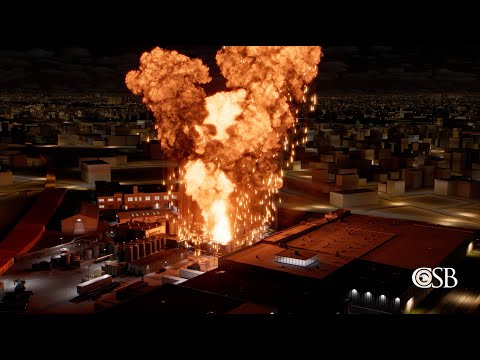
The closed manway "could not contain the pressure," the report says; hot resin and flammable vapor erupted through the manway seal, filling the kettle room and adjacent areas with a thick vapor cloud. About two minutes after the release began, the vapor cloud found an ignition source and caused a massive explosion and fire that burned for 11 hours and severely damaged the plant. The report cites significant property damage (approximately $90,000,000) and multiple employee injuries. The transcript contains inconsistent references to fatalities (an early passage describes one worker as fatally injured and a later passage describes a third employee as killed); the CSB's published report should be consulted for the final casualty count.
The CSB identified three primary safety issues: mechanical integrity of low‑pressure vessels; safeguard selection and the hierarchy of controls; and emergency preparedness. On mechanical integrity, investigators found Yanken Majestic performed a leak check of the new manway only up to 4 psig even though the kettle had a documented maximum operating pressure of 12 psig; the manway later failed at roughly 9 psig. The CSB noted that industry pressure‑vessel safety codes apply to vessels operating above 15 psig and that there is limited specific guidance for low‑pressure vessels that nonetheless operate in highly hazardous chemical service.
On safeguards and the hierarchy of controls, the CSB found the plant relied on administrative controls and equipment interlocks without configuring controls to prevent hazardous actions—specifically, the facility did not prevent adding solvent while the agitator was off and did not provide audible alarms so workers would be alerted to a gas release. "Facilities should use the hierarchy of controls to design and maintain fault tolerant systems," the CSB wrote, warning that systems dependent on a single human action can allow a chain of events to become catastrophic.
On emergency preparedness, the CSB said that many flammable‑gas detectors detected the cloud but were not configured to sound audible alarms to alert onsite workers; employees were not trained to recognize and respond to the hazard and some personnel approached the release rather than evacuating. The board recommended installing detectors that trigger both visual and audible alarms, increasing operator training on hazard recognition, and requiring flame‑resistant personal protective equipment in operating areas that process flammable chemicals.
The CSB also recommended that standards bodies, including the American Petroleum Institute and the American Society of Mechanical Engineers, develop specific guidance for design, construction and alteration of low‑pressure process vessels in flammable and other highly hazardous service. The board called on similar facilities nationwide to review the three safety issues and apply the report's lessons to prevent comparable incidents.
The CSB video and report contain the technical details summarized here; for the board's full report and final casualty totals, the CSB's published report and website are the authoritative sources. The investigation concluded with recommendations to the company and to standards bodies; the CSB closed the presentation by urging industrywide implementation of those recommendations.