Get Full Government Meeting Transcripts, Videos, & Alerts Forever!
Get email alerts on the Grant Funding NOFO topic
No spam. Unsubscribe anytime.
ACF webinar details HEART NOFO: funding up to $1.25M per year, eligibility, curriculum and performance rules
Summary
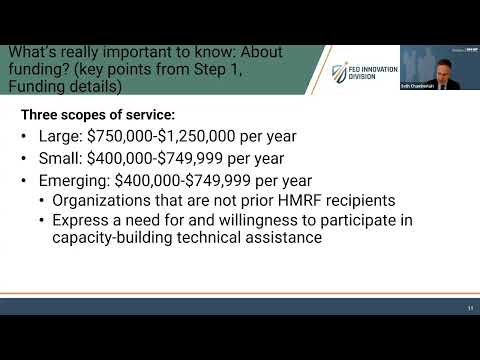
The Administration for Children and Families’ Office of Family Assistance walked applicants through the Helping Every Area of Relationships Thrive (HEART) Notice of Funding Opportunity, outlining funding ranges ($400,000–$1,250,000/year), eligible applicant types, required curriculum and participant targets, and performance measurement expectations.
Seth Chamberlain, a presenter with the Administration for Children and Families’ Office of Family Assistance, opened a recorded webinar on the Helping Every Area of Relationships Thrive (HEART) Notice of Funding Opportunity and summarized what applicants must know to apply.
Chamberlain said the program funds five‑year project periods and that applicants may request between $400,000 and $1,250,000 per year. “The annual appropriation is $150,000,000 for healthy marriage and responsible fatherhood, and $75,000,000 is set aside for healthy marriage,” he said. Continuation funding after the first year is conditioned on availability of funds, satisfactory progress against performance benchmarks and a federal determination that continued funding is in the government’s interest.
Applicants must select one or more of seven authorized activities in the NOFO—examples include public advertising campaigns linked to recruitment, marriage and relationship education and skills (MREs), premarital education, marriage enhancement/divorce reduction programs, mentoring, and activities to reduce disincentives to marry. Grantees are expected to implement at least one specific evidence‑informed, skills‑based program model and deliver primary workshops that provide a minimum of 12 hours of curriculum delivered across more than two sessions and over at least two weeks.
The webinar emphasized participant eligibility and minimum service targets tied to funding scope. HEART serves adults ages 18 and older; participation must be voluntary. Minimum annual service commitments are: large scope ($750,000–$1,250,000/year) — at least 200 individuals or 100 couples who complete 90% of primary workshops; small scope ($400,000–$749,999/year) — at least 120 individuals or 60 couples; and an Emerging scope (new in this NOFO) with phased year‑by‑year minimums (for example, at least 30 individuals or 15 couples in year 1, rising to at least 120 individuals or 60 couples by years 4–5).
Chamberlain stressed safeguards applicants must include: consultation with domestic violence experts, domestic‑violence information and safe disclosure procedures in workshops, staff training on responding to disclosures, and staff knowledge of state child abuse and neglect reporting requirements. He also listed unallowable costs—examples given were construction, supplanting other funds, legal assistance, direct health or mental‑health treatment, child support payments, rent or housing subsidies, and substance‑abuse treatment—and urged applicants to form partnerships to link participants with services the grant cannot fund.
Kalia Thomas (presenting Step 3 application guidance) walked through what to submit: two files (file 1: project narrative including table of contents, summary, project narrative and line‑item budgets; file 2: attachments) plus standard forms. She reiterated that reviewers will score applications only on materials in the NOFO/application package and listed required attachments (indirect cost agreements, legal proof of status, documentation of organizational capacity, third‑party agreements and letters of support). The webinar noted a combined page limit of 100 pages for the two files (standard forms excluded).
Tanya Matthews summarized scoring: merit review criteria are weighted (Approach 45 points; Organizational capacity 30; Project management/staffing 15; Performance measures/CQI/logic model 3; Budget 7). Reviewers will not consult external materials; the agency also considers geographic distribution, serving emerging or underserved populations and applicants’ past performance when making awards.
Chamberlain corrected a slide error at the end of the webinar, confirming the agency’s stated aim to fund 14 Emerging scope applicants in this competition. For application assistance he provided a contact (Taffy Compain) and Office of Grants Management staff (Talina Bennett Reid), and reminded applicants to establish SAM.gov and Grants.gov accounts before applying.
The webinar closed with a reminder that awards will be cooperative agreements with substantial OFA involvement post‑award (program specialists providing guidance and review), and with encouragement for qualified organizations to apply.
Ending: The NOFO remains the definitive source for application details; this webinar summarized its major requirements, scoring priorities and contacts for technical questions.