Get Full Government Meeting Transcripts, Videos, & Alerts Forever!
Get email alerts on the Zoning topic
No spam. Unsubscribe anytime.
Planning commission declines to recommend extended‑stay hotel at Lakeside Crossing amid parking and density concerns
Summary
The commission voted not to recommend ZPD25‑0008, a proposal to allow an extended‑stay Residence Inn with up to 138 rooms at Lakeside Crossing, after residents and commissioners raised parking, traffic and density concerns. Staff and developers had argued the project would generate local tax value and serve nearby businesses.
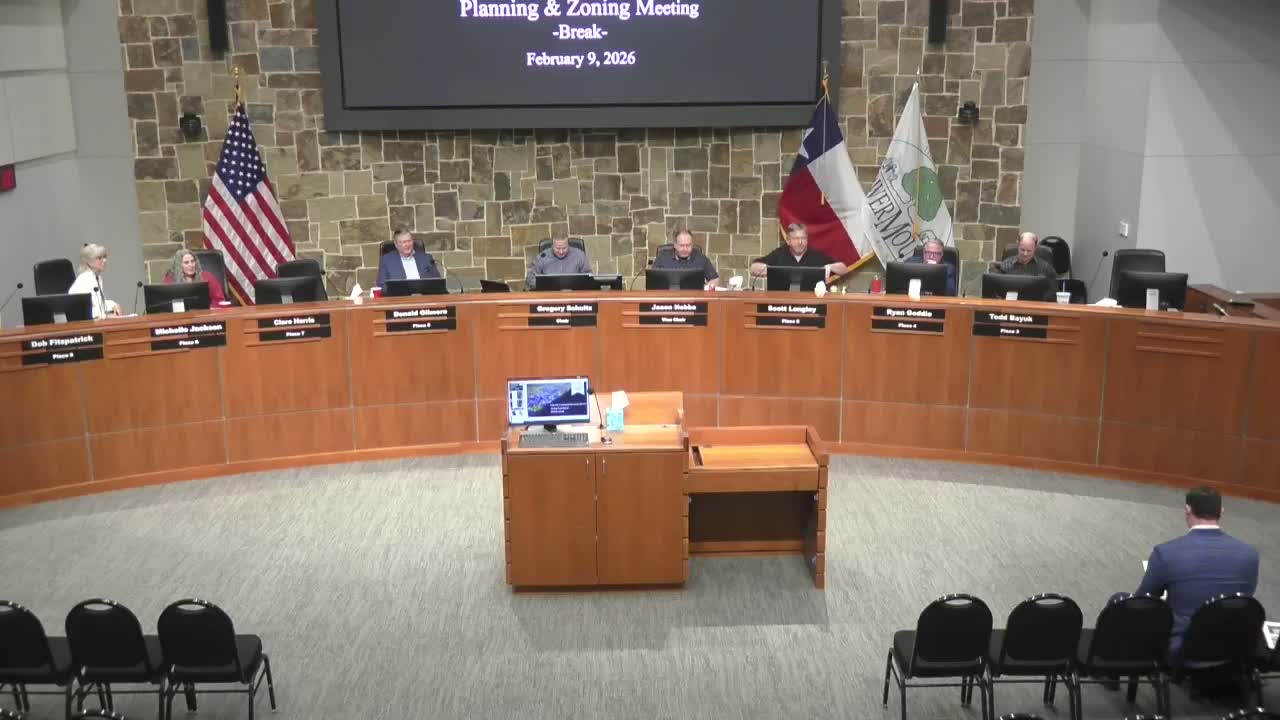
At its meeting, the Flower Mound Planning & Zoning Commission voted to not recommend a zoning amendment (ZPD25‑0008) that would allow an extended‑stay hotel on Lot 1 of the Lakeside Crossing development. The amendment would have amended PD‑153 to allow an extended‑stay Residence Inn by right, increase permitted density and change parking and design standards.
Claire Barnes, planning staff, told the commission the request would permit a five‑story extended‑stay hotel of up to 138 rooms and sought multiple modifications to PD‑153, including an increase in density to about 55 rooms per acre, a modified parking ratio (applicant study proposed 0.76 spaces per room), blade signs and adjustments to architectural standards. Staff also reported 45 pieces of correspondence in opposition and five in support received shortly before the meeting.
Developer representative Nick Reddy argued the hotel would serve the market for midweek business travel and local sporting events and said the proposal would generate municipal tax value. "Based on the current underwriting assumptions, we've shown in our model we are projecting about 1,000,000 dollars in tax value generated annually," Reddy said, asserting the project would keep hotel spending in Flower Mound. He also told commissioners that Residence Inn stays tend to be short: "In 2025, the average stay in Residence Inns nationally was 3 nights on the dot," which he said supported the developer's parking analysis.
Residents and several commissioners disputed the parking analysis. Kevin Hutchins, a Lakeside townhome resident, told the panel he had studied the applicant's parking study and said on evenings the existing lots already fill: "The existing parking lot on the weeknights gets full pretty quick... The parking study, I spent an hour looking at it today and didn't get anywhere on it." Other residents raised similar concerns about spillover into adjacent streets and the loss of green space.
Commissioners pressed staff and the applicant on net changes to on‑site parking, how nearby undeveloped lots would factor into future parking supply, and the option of conditioning any approval on a shared‑parking agreement or a reduced room count. Staff and the developer said the applicant could pursue shared‑parking arrangements and that the operator could explore a minor reduction in rooms; during deliberations the applicant indicated an openness to discuss moving toward the previously approved 134‑room concept.
After extended discussion about traffic flow, the effect of shared parking, and neighborhood perceptions of extended‑stay uses, a commissioner moved to not recommend the zoning amendment. The motion carried on a majority vote; the commission directed that its recommendation (not to recommend) be forwarded to the town council. The applicant may revise the proposal and return to the commission, or present the item and the commission's recommendation to council for final consideration.