Get Full Government Meeting Transcripts, Videos, & Alerts Forever!
Get email alerts on the Zoning Planning topic
No spam. Unsubscribe anytime.
Court asks staff for counts on RR-to-AG conversions, to define —agricultural' uses and to revive stormwater task force
Summary
Franklin County court directed planning staff to report trend data on rural-residential-to-agricultural rezoning, to help define what belongs in the agricultural district during a code rewrite, and to revive the county's stormwater task force after recent flooding.
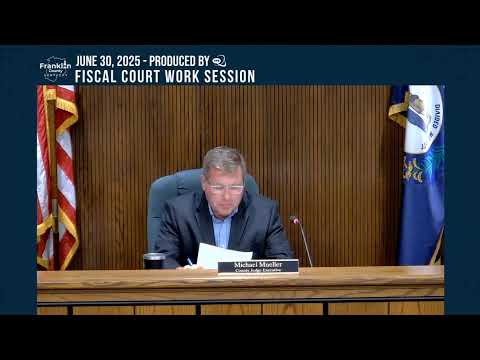
At its June 30 work session, the Franklin County court directed staff to gather application counts and trend information on requests that change land from rural-residential (RR) to agricultural (AG), and asked that staff bring a clear description of permitted agricultural uses to the court as part of an ongoing zoning code rewrite.
Squire Wiseman urged the court to collect data and to develop a definition of the agricultural district so the body could consider whether to ask the planning commission or county counsel for further action. "I'd like some clarification to the court in terms of, the number of applications that have come through, for zoning issues that are changing a rural residential to an agricultural purpose," he said, pressing for a multi-year trend (he and others suggested five years as a starting point).
Members agreed the code rewrite and retained planning consultants should help craft any definitions; Max cautioned the court to be mindful of state law, pointing to KRS 101 as providing a statutory definition of agricultural use and noting the county's ability to be more restrictive could be limited by state definitions.
The court also discussed value-added products when considering the definition of —agricultural product.' Scott Tanner said, "I think to not beat around the bush is alcohol an agricultural product, period," prompting discussion about whether products created from farm-grown ingredients (jams, distilled spirits, processed foods) should fall under agricultural uses or be treated separately in zoning and conditional-use rules.
Finally, the court agreed to revive its stormwater task force and to have staff coordinate participation and report back in light of recent flooding and gaps in federal mitigation funding.
No new ordinance or definition was adopted at the meeting; the court requested staff develop the data and draft language for future consideration during the zoning-code rewrite process.