Lifetime Citizen Portal Access — AI Briefings, Alerts & Unlimited Follows
Training module models effect of poll worker shortages on voter wait times
Loading...
Summary
An instructional SMILE training module uses discrete event simulation to model poll worker shortages at three hypothetical voting locations, estimating effects on voter wait times and testing mitigation strategies. The module assumes about 1,500 voters per site with morning and evening surges.
A presenter in a training module for the SMILE project outlined how discrete event simulation can be used to model poll worker shortages and their effects on voter wait times across different polling-site setups. “This module explores poll worker shortages occurring during election day,” the presenter said.
The module examines three hypothetical voting locations: a paper-based site using paper poll books, hand-marked paper ballots and ballot boxes; a technology-based site using electronic poll books, electronic ballot-marking devices and electronic scanners; and a hybrid site combining electronic poll books with hand-marked paper ballots and electronic scanners. “As part of this investigation, 3 hypothetical voting locations are explored,” the presenter stated.
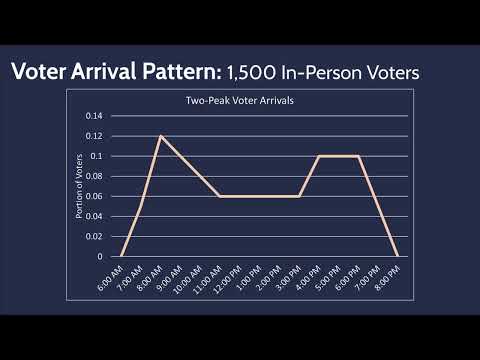
For the simulations, the presenter said the model assumes about 1,500 voters will arrive at each voting location over the course of election day and that arrivals follow a pattern with a morning surge, fewer midday arrivals and another evening surge. “We assume that approximately 1,500 voters arrive throughout election day at each voting location and that voters arrive following the pattern shown on screen,” the presenter said.
Using discrete event simulation, the module models how limited operational capacity from poll worker shortages affects voter wait times and tests strategies intended to mitigate those impacts. “Using discrete event simulation, we’ve modeled voting locations experiencing a poll worker shortage to assess the impact of limited operational capacity on voter wait times and determine the effectiveness of strategies to overcome a poll worker shortage,” the presenter said.
The presenter said the module’s remaining videos will present general findings and provide in-depth exploration of opening and closing operations and voting operations under shortage scenarios. Viewers are directed to select additional videos in the series to review specific scenarios and recommended operational approaches.
The presentation is instructional material, not a formal report of an actual election. The module documents modeled scenarios and assumptions (site types, voter-arrival profile, and staff-shortage conditions) and is intended for training and planning purposes, not as an official operational directive.