Lifetime Citizen Portal Access — AI Briefings, Alerts & Unlimited Follows
Presenter: Scanner failures can turn short lines into hours-long waits in simulations
Loading...
Summary
A presenter’s simulation of two hypothetical polling places with 1,500 voters shows 30-minute repairs cause modest delays while 2-hour outages can push hourly waits past two hours; options include quick repair, temporary ballot boxes, or adding a second scanner.
A presenter in a video simulation found that electronic ballot scanner outages can sharply increase voter wait times and create large backlogs unless election workers restore scanning quickly or use contingency methods.
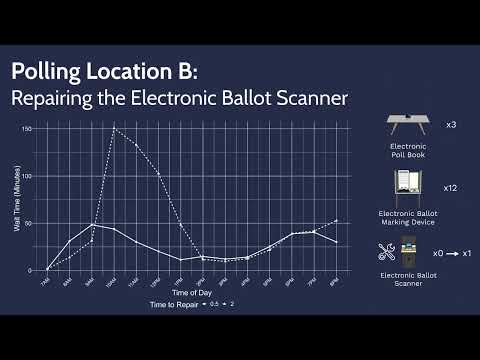
The simulation modeled two hypothetical polling locations with 1,500 total voters on election day. Polling Location A had three electronic poll books, 10 privacy booths and one electronic ballot scanner; Location B had three electronic poll books, 12 ballot-marking devices and one electronic ballot scanner. When all equipment functioned, average wait times were 12 minutes in Location A and 26 minutes in Location B.
The presenter simulated a scanner failure at 8:15 a.m. and compared two repair timelines. In Location A, a 30-minute repair increased the day-average wait time to 17 minutes and produced a 39-minute peak at 9 a.m. A two-hour repair sent the longest hourly wait to 2 hours 13 minutes at 10 a.m. and raised the overall average wait to 51 minutes. In Location B, a 30-minute repair produced a longest hourly wait of 48 minutes, while a two-hour repair raised the day-average to 1 hour 4 minutes with a peak of 2 hours 30 minutes at 10 a.m.
The simulation also examined replacing a broken scanner with a ballot box for later central scanning. In Location A, swapping to a ballot box within 30 minutes produced a longest wait of 26 minutes and an average of 13 minutes for the day; a two-hour replacement raised the peak to 1 hour 56 minutes and increased the daily average from 12 to 34 minutes. In Location B, a 30-minute replacement raised the average only slightly (26 to 28 minutes), but a two-hour replacement increased the average to 46 minutes and the peak to 2 hours 10 minutes.
The presenter noted tradeoffs for the ballot-box option: it prevents voters from using the scanner’s ballot-correction feature and may make voters uncertain that their ballots will be counted. The video’s central takeaway was summarized by the presenter: “In summary, electronic ballot scanners breaking down during an election day can lead to significant voting delays.”
As mitigation, the simulation showed three practical options: rapid on-site repair (minimizing outages to about 30 minutes), substituting a secure ballot box for later tabulation, or provisioning two scanners per polling place to avoid total stalls. The presenter also warned that provisioning extra scanners can be costly and may result in over-allocation in low-turnout jurisdictions.
The video does not present real-world empirical results from an actual election; it reports outcomes from a model run with the parameters described on screen and therefore should be treated as illustrative rather than definitive.