Get Full Government Meeting Transcripts, Videos, & Alerts Forever!
Get email alerts on the Triage Challenge topic
No spam. Unsubscribe anytime.
DARPA program manager Jeremy Pamplin outlines triage challenge to speed casualty care
Summary
Jeremy Pamplin, a former Army medical intensivist and DARPA Biological Technologies Office program manager, described the DARPA Triage Challenge: competitions to develop robotic and algorithmic tools to locate, assess and prioritize casualties in battlefield and disaster mass-casualty scenarios. Details such as prize amounts and dates were not specified.
Jeremy Pamplin, a former Army medical intensivist and a program manager in the Defense Advanced Research Projects Agency's Biological Technologies Office, described the DARPA Triage Challenge, a competition intended to speed identification and prioritization of casualties during battlefield and disaster mass-casualty events.
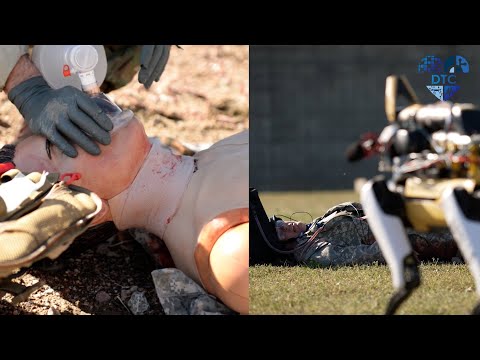
Pamplin said the challenge combines cutting-edge algorithms and real-time sensor data to "rapidly find, accurately assess, and prioritize casualty care at the point of injury." He emphasized the stakes: "In the chaos of mass casualty events... the speed and accuracy of locating casualties and prioritizing their care can mean the difference between life and death," Pamplin said.
The program's first year featured three distinct contests — systems, data and virtual competitions — with teams from around the world. Pamplin said this year the challenge will focus on two tracks: systems and data, and that the organizers have increased the difficulty and the reward for top teams; the transcript did not specify monetary amounts, prize structures, or contest dates.
In the systems challenge, Pamplin said teams must field robotic platforms capable of finding and assessing casualties in near-total darkness, through smoke and other partial occlusions, and distinguishing between people who are alive, those who may be dead and those who are moving but still require sorting. "They will need to distinguish between casualties who are alive and those that may be dead," he said.
The data challenge requires teams to deploy bespoke, rapid algorithms on de-identified patient data that more closely represent the messiness of real-world casualty care, including noise and data dropouts. Pamplin said the goal is to identify life-saving interventions quickly and accurately from raw clinical data.
Pamplin also described a new validation event: a simulation that will pit a medic-only team against a medic aided by DARPA triage challenge technology to evaluate whether the technology improves outcomes in realistic disaster scenarios.
Pamplin framed the challenge as a step toward reducing the burden on first responders. "My personal vision and hope for this challenge is that it will catalyze a future where no medical professional has to make blind decisions under immense pressure," he said.
The transcript supplied no dates, locations, prize amounts, or details on team identities. Pamplin identified himself as the program manager for the DARPA triage challenge and repeatedly linked the work to DARPA's Biological Technologies Office priorities.
Pamplin concluded that the DARPA Triage Challenge is "laying the foundation for the future of combat casualty care [and] disaster triage," and said the effort is just getting started.