Lifetime Citizen Portal Access — AI Briefings, Alerts & Unlimited Follows
Census webinar shows how school leaders can use U.S. Census Bureau data to target resources
Loading...
Summary
Dr. Amy Brambles of the U.S. Census Bureau demonstrated data.census.gov, SAIPE and other Census tools in a webinar, showing how mapping poverty, language and mobility can help districts plan staffing, outreach and Title I needs assessments.
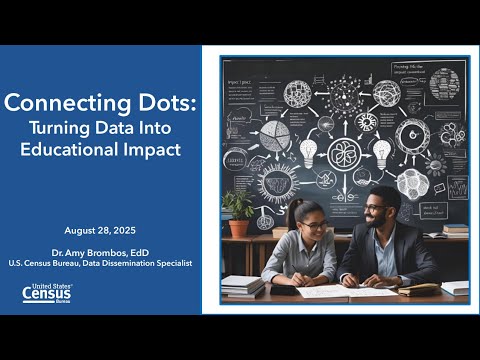
Dr. Amy Brambles, a data dissemination specialist at the U.S. Census Bureau, led a webinar demonstrating how school leaders can use Census Bureau tools — including data.census.gov and SAIPE — to map poverty, language and mobility and improve district planning.
Brambles said layering community data onto internal student records helps districts identify geographic concentrations of need and target services. “You can layer community data onto everything that you already know about your students,” she said, as she walked participants through an example using Buffalo City School District.
Why it matters: community indicators can change how districts allocate staff, design after‑school and career programs, and calculate Title I eligibility. Brambles highlighted that SAIPE (Small Area Income and Poverty Estimates) provides annual poverty figures used in Title I funding calculations and that the Census Bureau will share a short instructional “data gem” about SAIPE’s calculations.
Demonstration details: Brambles used data.census.gov’s advanced search and narrative profile to show nearly 2,000 datasets available for a large school district. Using Buffalo as an example — she said the district serves more than 32,000 students across roughly 52 square miles and has about 70 school buildings — she demonstrated filtering by topic (income and poverty, housing, language, school enrollment) and switching between 1‑year and 5‑year American Community Survey (ACS) estimates. She emphasized the ACS threshold rules: large geographies can receive 1‑year estimates while smaller geographies and ZCTAs may require 5‑year estimates.
On mapping, Brambles displayed a district‑level poverty measure (she showed 22.3% of families below the poverty level for an all‑families measure) and then added ZIP Code Tabulation Areas (ZCTAs) to reveal local variation, including ZCTAs with very high percentages of families in poverty. She cautioned administrators to check raw counts alongside percentages; in a filtered table for families with school‑age children she noted figures such as 45% of those families living in poverty and that 70% of families where the head of household has a high‑school diploma or GED or less live in poverty — numbers presented as examples from the selected tables during the walk‑through.
Brambles also demonstrated housing and mobility filters, noting that in the Buffalo example roughly 57% of families were renter‑occupied — a proxy she said for higher residential mobility and potential midyear student moves. She showed language tables (e.g., table S1601) that break down languages spoken at home by age and English‑proficiency, recommending that administrators use age filters to prioritize family engagement strategies. She then highlighted family relationship tables that identify grandparents raising grandchildren and provided example counts for a ZCTA and for the district (she cited roughly 5,000–6,000 such households in Buffalo City School District during the demo).
Q&A highlights: participants asked about projecting kindergarten enrollment for pre‑K expansion; Brambles recommended combining age‑cohort tables, ACS data, and birth records from state or county health departments and noted pre‑K cohorts are harder to project. She confirmed Census data access via an API and said the Census offers API training and webinars. She demonstrated downloading tables as Excel, CSV or zip files and how to export multiple vintage years for offline analysis.
Resources and next steps: Brambles pointed attendees to Census Academy (census.gov/academy), the data.census.gov portal, the SAIPE tool, the Statistics in Schools program, and the askdata@census.gov contact for specialized training and follow‑up. The webinar recording and Q&A will be posted with materials on the Census Academy site.
The presentation concluded with a short Q&A; unanswered questions and the Census Bureau’s responses will be posted with the webinar materials.