Get Full Government Meeting Transcripts, Videos, & Alerts Forever!
Get email alerts on the Trail Commercial Use topic
No spam. Unsubscribe anytime.
Trails advisory panel weighs three approaches to commercial motorized use; motion to send DNR-policy letter to mayor fails
Summary
Trail staff presented three options — a simple vehicle-weight policy, a parks-and-rec commercial-use policy tied to existing frameworks, or a codified trail-specific commercial-use program. Commissioners favored a hybrid approach and declined (3-3) to send a draft letter urging adoption of the Alaska DNR wheeled-vehicle policy to the mayor.
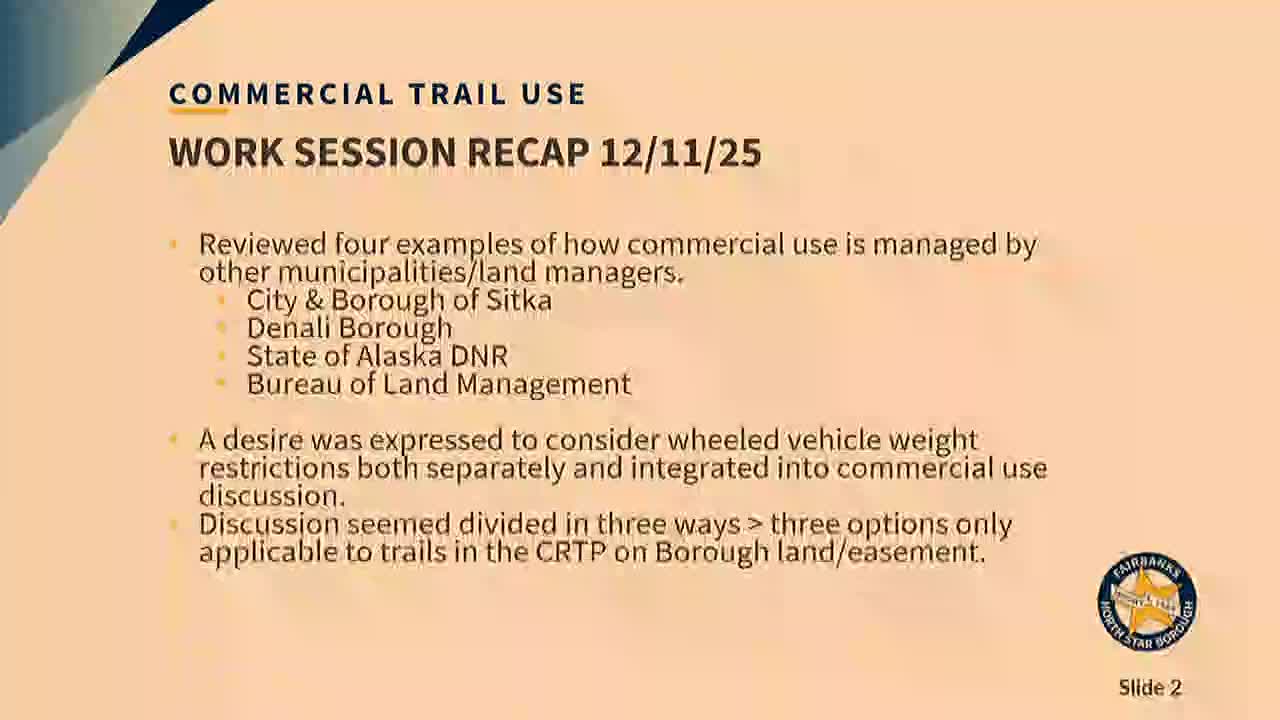
Andrea Jacobs, the borough’s trail coordinator, presented three options for managing commercial motorized use on borough trails, saying staff had reviewed practices used by Sitka, Denali Borough, the Alaska Department of Natural Resources (DNR) and the Bureau of Land Management.
Jacobs told the commission that option 1 would adopt a wheeled-vehicle policy focused on vehicle size and weight, option 2 would use a Parks and Recreation departmental commercial‑use policy that leans on existing land‑management frameworks, and option 3 would create a codified, trail‑specific commercial‑use plan with an approval/denial process and public comment. "Option 3 would be to develop a codified trail specific commercial use plan and program," Jacobs said.
The commission’s discussion centered on enforcement capacity, public‑comment opportunities and whether the borough should require permits, annual licenses or seasonal restrictions before codifying rules. Director Boyer explained that existing models — mobile concession permits, facility use agreements and six‑month land‑use agreements — could inform a trails policy but that trails differ because they often cross non‑borough land and are difficult to monitor.
Several commissioners urged an incremental approach. One commissioner said the key missing element is data on how many commercial operators use borough trails; another recommended keeping public comment and the approval/denial process in whatever framework the commission endorses. Mayor Hopkins told the body he expects commercial trail use to grow and said, "we should make a framework to make sure it happens in a way that works also with our neighborhoods." Jacobs agreed staff could draft a hybrid recommendation that combines the administrative simplicity of option 2 with the public‑comment and review features of option 3.
The commission then considered a separate agenda item: a draft letter recommending that the borough adopt the Alaska DNR wheeled‑vehicle policy for motorized trails. Helen Lefgren moved to approve and send the draft letter to the mayor, seconded by Ms. Davidson. After debate over whether to wait for staff’s mixed-policy recommendation and whether to add language about seasonality and the rationale for weight limits, the clerk called a recorded vote. The motion resulted in a 3-3 tie and failed, so the letter was not sent.
Commissioners asked staff to return with a blended policy draft and a spreadsheet of subitems (permit elements, weight/width limits, public‑comment triggers and enforcement options) for the commission to prioritize. Staff said it would aim to have a draft for the commission by the April meeting or sooner via a special meeting if needed.
What’s next: staff will draft a hybrid policy and a prioritization tool that incorporates vehicle weight/width considerations, permit structure and public‑comment mechanisms and will return to the commission for further direction.