Get Full Government Meeting Transcripts, Videos, & Alerts Forever!
Get email alerts on the Education Budget topic
No spam. Unsubscribe anytime.
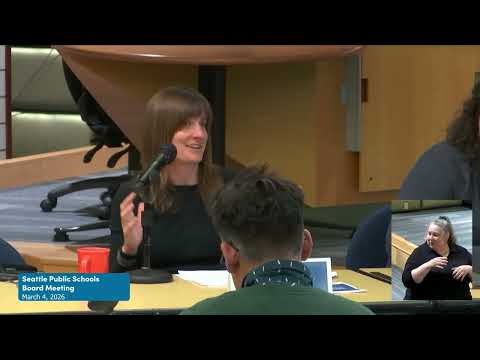
Seattle schools staff preview allocation and staffing changes to narrow multimillion-dollar shortfall
Summary
District staff told the school board they have narrowed a roughly $100 million shortfall but still expect to dip into fund balance next year. Proposed changes include tweaks to the weighted-staffing model, a CTE ratio shift, central-office reductions and an estimated $9.5 million in school-level savings; staff said they will protect jobs through attrition and a 35% mitigation reserve.
Seattle School District No. 1 staff presented the board on a series of proposed budget and allocation changes they say will narrow a multiyear shortfall while protecting classroom employment.
"This district is facing some pretty significant financial hardships," Superintendent Scholdner told the board, framing the presentation as an update on assumptions and options rather than final decisions. Staff warned the figures are fluid, changing with legislative action and enrollment shifts.
Dr. Buttleman, presenting details of the district's assumptions, said recent state revenue reforecasting reduced the deepest cuts staff had expected but also produced several unanticipated impacts. He told the board that a change in the STARS formula for bus depreciation could reduce Seattle's revenue by about $1 million and that the district's $400,000 grant for beginning-educator support (two FTE) is at risk. Staff also said they had included roughly $2 million in their deficit estimate to reflect a new sales tax treatment of some temporary staffing services.
Board members pressed for clarification about how the district would cover those costs. Director Rankin asked whether safety-net funding intended for students with disabilities would be tapped to pay the new tax; Dr. Buttleman said the district would bill OSPI for eligible safety-net costs and did not expect tapping that funding to reduce eligibility for services.
On allocations to schools, staff described specific changes to the Weighted Student Staffing (WSS) model that drive teacher allocations. Among the technical proposals are moving several Career and Technical Education (CTE) allocations toward a 32:1 student-teacher ratio, raising the secondary allocation to 32:1 for grades 6—612 and adjusting grades 4—5 to 28:1. Staff said the tweaks are being developed within the constraints of the district's collective-bargaining agreement with SEA and stressed that the changes are allocation rules rather than immediate class-size caps.
Marnie, a staff member working on school budgets, told the board nontraditional programs show the sharpest AFTE declines, and principal-level budget work is underway. She said the district saw improved open-enrollment results: as of March 2 the district had about 870 students on wait lists (compared with roughly 2,000 at the same point last year) and that many families on wait lists still hold assignments.
Staff projected about $9.5 million in school-process savings from the proposed allocation changes and estimated central-office reductions in the range of $8—15 million. Other possible savings discussed included negotiating bus vendor volume discounts and routing efficiencies (staff estimated roughly $3.5 million potential), reallocating some roles to grant funding, limiting travel and consulting costs, and pursuing a one-time federal energy tax-credit refund related to geothermal/solar projects that could yield a one-time ~$5 million if documented and processed correctly.
The district also noted a one-time interfund-loan accounting outcome: $16 million that had been anticipated for repayment this year will not need to be repaid because the loan was not utilized, which improves the near-term picture.
Scholdner emphasized staff's goal of avoiding involuntary layoffs. "I don't want anybody to lose employment because of changing from 31 to 32," he said, describing an approach that relies on attrition, displacement and a mitigation reserve. Dr. Buttleman said the draft budget preserves roughly 35% of the identified savings as a reserve to soften staffing impacts while schools implement allocation changes.
The district's projection for next year varies with several moving parts: staff said if certain legislative or enrollment shifts go their way the district could limit use of fund balance to the low tens of millions; under the current conservative estimates staff said they may draw into fund balance in the range of $10 25 million next year. Staff reiterated that the goal is to stop multiyear drawdowns of the rainy-day fund and to rebuild reserves over time.
What's next: staff will provide memos to answer directors' detailed questions (Medicaid reimbursement, the specific calculations that produced outlier school projections, and the data behind the 15% reservation for choice seats) and will continue school-level budget development. A formal public hearing on the proposed budget is planned for July, with adoption targeted in August.
Authorities referenced in the presentation included the STARS funding formula, the district's WSS allocation model and the district's collective-bargaining agreement with SEA; staff said all proposed allocation changes are being designed to comply with existing contract and state rules.
Ending: The board did not take formal action during the session; staff will return with more detailed memos and refined budget numbers as negotiations and legislative work proceed.