Lifetime Citizen Portal Access — AI Briefings, Alerts & Unlimited Follows
Census Bureau previews 2024 ACS 1‑year release, warns population control change may affect comparability
Loading...
Summary
U.S. Census Bureau officials previewed the 2024 American Community Survey (ACS) 1‑year products, announced embargo and public release dates, described new race and housing tables and said a Population Estimates Program methodology change added about 5 million people to the 2024 population controls that the ACS uses.
The U.S. Census Bureau previewed the 2024 American Community Survey (ACS) one‑year data products in a prerelease webinar, announcing embargoed access for media and flagging a Population Estimates Program (PEP) methodological change that increased 2024 population controls by about 5,000,000 people and could affect year‑to‑year comparisons.
Caleb Hoppler, supervisory survey statistician with the American Community Survey Office, said embargoed media will be able to access the 2024 ACS 1‑year estimates beginning Tuesday, Sept. 9 at 10:00 a.m. Eastern and that the public release is scheduled for Thursday, Sept. 11 with data.census.gov and other tools updated by 10:00 a.m. Eastern on release day; the embargo lifts at 12:01 a.m. Eastern on Sept. 11. "There was a cumulative increase of about 5,000,000 people for the 2024 estimate of the total population which the ACS is controlled to," Hoppler said, cautioning that the change in PEP's net international migration estimates is one factor users should consider when comparing years.
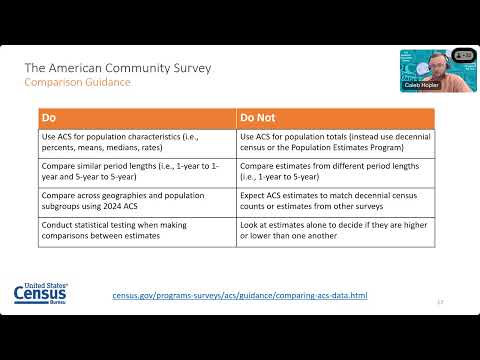
Hoppler reviewed the ACS's scope and purpose, saying the survey samples roughly 3.5 million addresses and about 150,000 group‑quarter residents annually to produce social, economic, housing and demographic estimates for national, state and substate geographies (the 1‑year release covers areas with populations of 65,000 or more). He urged data users to compare rates, means or percentages and to account for margins of error rather than comparing raw totals across period lengths.
The webinar outlined several product and documentation changes for 2024. Hoppler said the release adds six new race tables and two new detailed housing tables (including tables B25142 and B25143 on monthly homeowners association and condominium fees) and improves tabulation for detailed white and Black or African American groups. He also described updates to journey‑to‑work and migration tables (for example, changes to wording for taxi/ride‑hailing categories) and the addition of specific rows such as an "Afghan" row in select tables.
Key data releases and schedules announced during the webinar include the 2024 ACS 1‑year PUMS and 1‑year supplemental estimates (geographies with populations of 20,000 or more) on Oct. 16, the 2020–2024 five‑year estimates with an embargo on Dec. 9 and public release on Dec. 11, and the 5‑year PUMS and variance replicate files on Jan. 22. Hoppler also pointed attendees to technical documentation, table shells, the Census API, data.census.gov and the My Congressional District tool for accessing and testing estimates.
During the Q&A, a caller identified as Emma Cohn asked whether poverty and income tables by race and ethnicity would be released on Sept. 11. A Census subject matter expert in poverty statistics (identified in the webinar as Scribe Madison) replied, "you will find both income and poverty statistics by race released next week." Another caller, James Schwartz, asked about converting PUMA‑based 1‑year estimates to county geographies; Mike Starcinec, chief of the ACS variance estimation branch, recommended continuing to use Missouri State Data Center conversion files, saying that was "most likely your best option."
Jewel Jordan, a public affairs specialist in the Census Bureau's Public Information Office, reviewed embargo rules for media access (accredited media with individual registration and a media‑affiliated email), provided contact information for the Public Information Office and reminded users to cite the Census Bureau's American Community Survey when using ACS estimates. The webinar recording and slides will be posted with the press kit.
The Bureau asked attendees to submit an evaluation and sign up for ACS updates by email. For embargo or press questions the Public Information Office provided pio@census.gov and (301) 763‑3030 as contact points.