
Parks board signs off on SprayTech training, emergency zoo repairs and support letter for septic-elimination project
Get AI-powered insights, summaries, and transcripts
Subscribe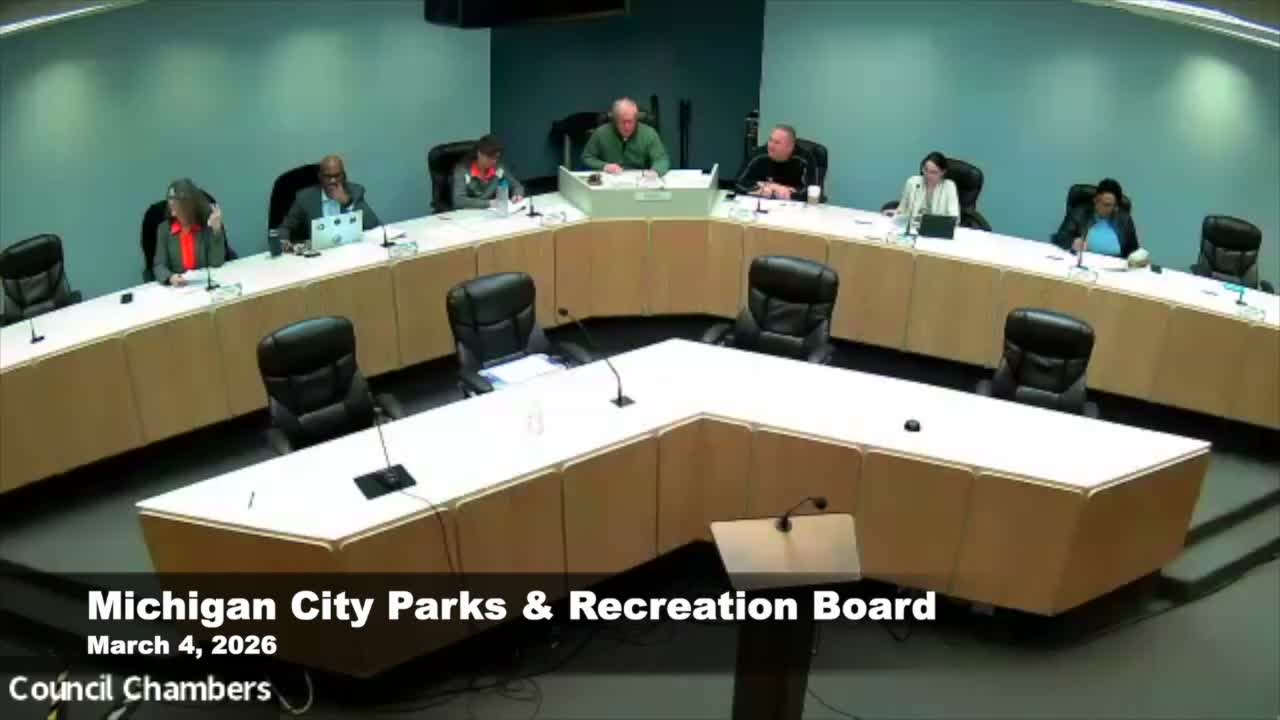
Summary
The board approved a $25,000 SprayTech training agreement to certify a new pesticide-applicator assistant, authorized emergency repairs at the zoo (furnace and walk-in cooler) and adopted a letter supporting the Michigan City Sanitary District’s septic-elimination project to reduce E. coli contamination at Trail Creek and Lake Michigan.
The Michigan City Parks and Recreation Board on March 4 approved a set of operational items: a one-season SprayTech professional services agreement for training an assistant to obtain a pesticide-application license, emergency repairs at the zoo, and a letter supporting a sanitary-sewer extension project intended to reduce E. coli pollution in Trail Creek and Lake Michigan.
Staff explained that the assistant green superintendent accepted another job and that the department plans to promote and train an internal employee; the board agreed to bring Tony Staley back as the contractual trainer. The training cost for the season was cited as $25,000 and the agreement was described as similar to prior spray-tech contracts, with attorney-recommended indemnification language adjusted for the city’s protection.
"We'd like to bring Tony Staley back in," staff said, noting the scope is scaled to training rather than full spray operations. Public commenters asked whether training is a one-time expense that reduces future costs; staff replied that training is intended to lower long-term contracted costs once certified employees remain on staff.
The board also approved two emergency purchases at the zoo. Staff described an urgent furnace failure in the zoo vet clinic that required Saturday service to protect temperature-sensitive animals; Stephanie Heating and Air performed the work. Separately, a walk-in cooler experienced low temperature readings that threatened thousands of dollars of food; A and S Mechanical completed emergency repairs. The board approved both special purchase requests, with staff noting both were reviewed by the board attorney.
On environmental infrastructure, the board adopted a letter supporting the Michigan City Sanitary District’s urban-core septic-elimination project and directed staff to send it to Representative Frank Marvin. The letter notes the parks department’s concern about E. coli contamination, references 71 beach closures and 470 advisories dating back to 2012, and frames sewer extension as a step toward pollution reduction.
In other business staff updated the board on the Singing Sands trail phase 3 crossing negotiations with Amtrak and INDOT, noting the city previously lost grant funding (roughly $1.4 million) on a timeline issue and that condemnation of several small parcels remains part of the project. Staff said they have funding to continue acquisition and will pursue design agreements and coordination among the parties.